
Loan Amortization Calculator: Break Down Every Payment
How the Loan Amortization Calculator Works
A loan amortization calculator turns confusing loan math into something you can actually see. Instead of guessing what a loan really costs, you enter a few details and instantly get calculator results you can trust and compare.
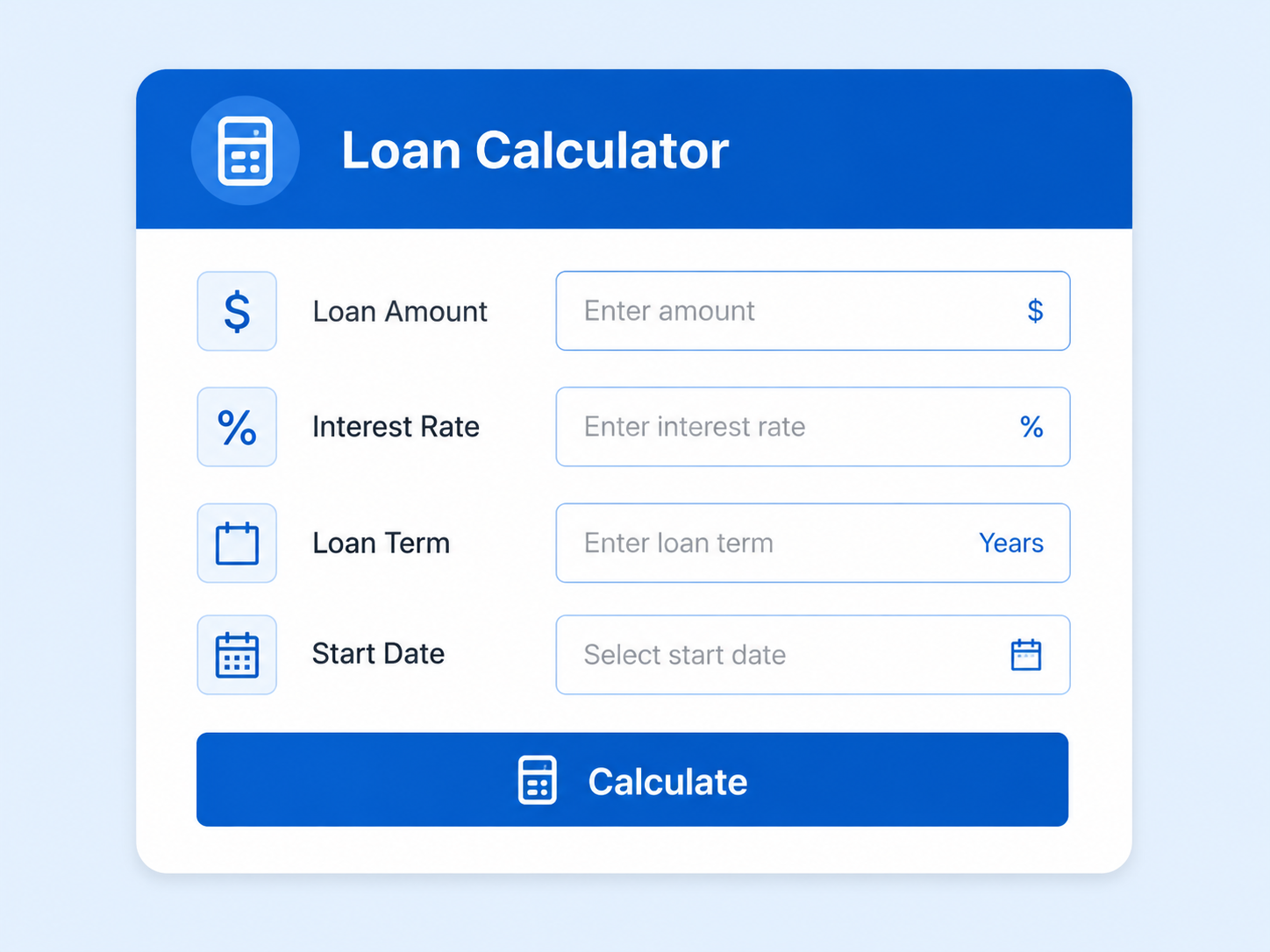
Learning how to use amortization calculator tools starts with understanding what each field means. The tool needs specific loan calculator inputs before it can process anything, and skipping or misjudging even one of these values changes every number that follows in your results.
Behind the scenes, the calculator applies the amortization calculator formula inputs to a standard financial formula. It does not guess or estimate; it performs the same fixed calculation a bank or lender would use to generate your official repayment figures.
Most calculators separate their fields into two groups: information the tool absolutely requires, and information that only applies in certain situations. Knowing the difference helps you fill out the form correctly the first time, without wasted trial and error.
Required Inputs (Loan Amount, Interest Rate, Term, Start Date)
Every accurate projection begins with four required fields: the principal amount, the annual interest rate, the loan length, and the loan start date. Miss one of these, and the calculator simply cannot produce a usable result.
The principal amount is the actual sum borrowed, before any interest is added. The annual interest rate determines how much that principal grows over time, and even a small difference in rate changes the total cost significantly across a long loan.
Term length, expressed as the loan term in years, tells the calculator how many payments to spread the balance across. The closing date or loan start date anchors the entire schedule, setting the timeline for every payment that follows.
Optional Inputs (Extra Payments, Payment Frequency)
Beyond the required fields, most calculators let you customize how you actually intend to repay the loan. These optional settings do not change the base loan terms, but they can dramatically reshape your real payoff timeline and interest cost.
An extra principal payment field lets you model paying more than the minimum each period. You might also enter a one-time lump sum payment, such as a bonus or tax refund applied directly to the balance in a single month.
Payment frequency settings let you compare standard monthly billing against biweekly payments or an additional monthly payment habit. Testing these scenarios side by side shows how small behavioral changes affect the loan's total lifetime cost.
Reading Your Calculator Results
Once you submit your inputs, the tool returns several key figures at once. The monthly payment amount appears first, showing exactly what you owe each period under the fixed terms you entered into the form.
Below that sits the total interest paid over the life of the loan, alongside the total cost of loan, which combines principal and interest together. These two numbers often surprise borrowers who only focused on the monthly figure.
Finally, most tools display a projected payoff date and generate a full amortization schedule output, listing every payment individually. Together, these results give you a complete, transparent picture of the loan from the first payment to the last.
How Loan Amortization Is Calculated (The Formula Explained)
Behind every calculator sits a well-established mathematical formula. The amortization formula does not vary by lender or institution; it is a standardized calculation rooted in the mathematics of the present value of annuity.
This formula converts a lump sum of borrowed money into a series of equal payments over time. Each payment reflects both the interest rate per period and the number of payments, balancing the two so the loan reaches zero on schedule.
Understanding how to calculate loan payment by hand is not required to use a calculator, but it builds genuine confidence. Once you see where the numbers come from, the results stop feeling like a mysterious output and start feeling like simple arithmetic.
The loan payment formula treats every loan the same way regardless of purpose, whether it funds a home, a vehicle, or a business expense. Only the specific numbers change; the underlying mathematical structure stays constant across nearly every fixed-rate product.
The Monthly Payment Formula
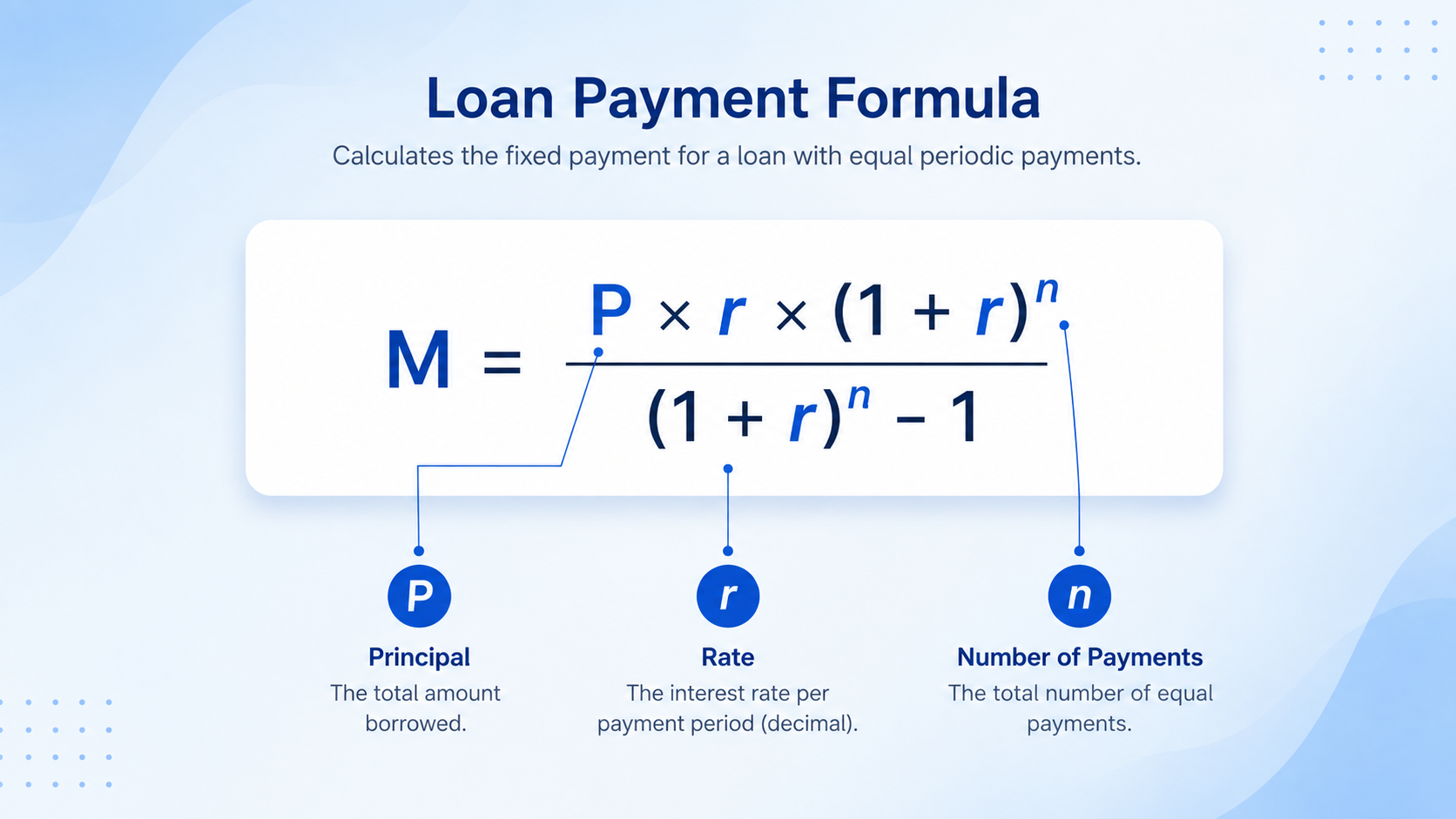
The fixed payment formula used in amortization is often written as an annuity formula, expressing payment as a function of principal, rate, and term. It looks intimidating at first glance but breaks down into manageable, logical pieces.
At its core, the formula multiplies the principal times rate to establish a baseline interest cost, then adjusts that figure using the periodic interest rate raised to a power based on total payments remaining.
How Each Payment Splits Between Principal and Interest
Every fixed payment you make is actually two payments combined into one. Part of it covers the interest portion owed for that period, while the rest reduces the principal portion, the actual amount you originally borrowed.
The remaining balance after each payment determines how much interest accrues next time. Because interest is always calculated on what is currently owed, the interest calculation per period produces a smaller interest charge as the balance shrinks.
Worked Example: Calculating a Payment Step by Step
Consider a simple amortization example using a $20,000 loan example at a fixed annual rate over a five-year term. Plugging these numbers into the formula produces one consistent monthly payment for the entire loan.
This sample loan calculation starts with converting the annual rate into a monthly rate, then applying it against the outstanding principal. The result becomes the interest owed for month one, calculated before any principal reduction happens.
Understanding Your Amortization Schedule (Table)
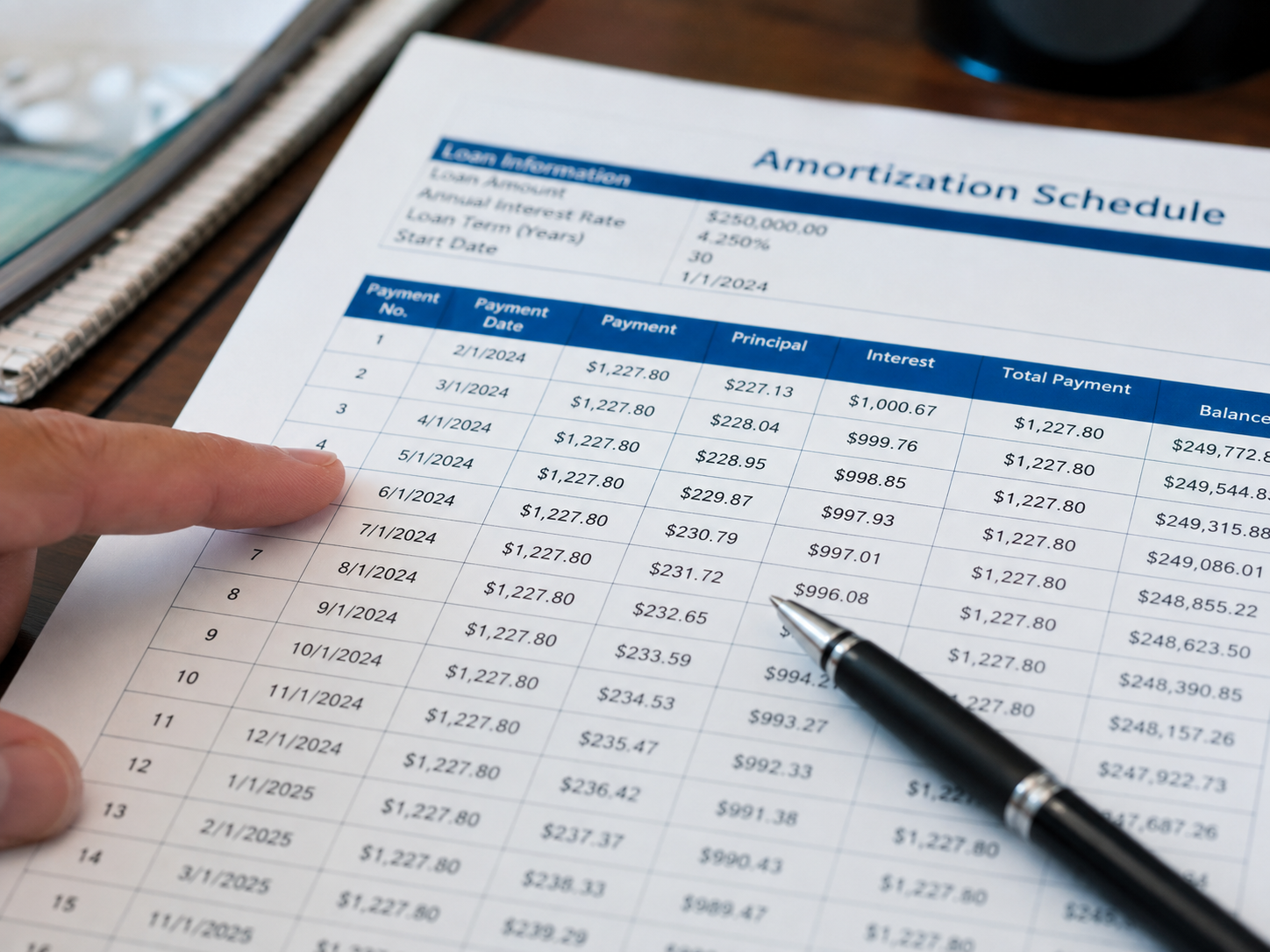
Once the formula runs, its output takes the shape of an amortization schedule, sometimes simply called an amortization table. This document lists every single payment across the entire loan term in organized, chronological order.
Each row in the table represents one payment number, moving sequentially from the first payment to the very last. Reading down the table shows exactly how the loan evolves period by period until the balance disappears entirely.
The table exists because a single monthly figure cannot convey the full story of a loan. Seeing every beginning balance and ending balance side by side reveals patterns that a lump-sum summary simply cannot communicate.
Many borrowers only glance at their monthly payment amount, never realizing how much information sits inside the full schedule. Reviewing it periodically builds financial awareness and clarifies exactly how much progress has actually been made.
What Each Column in the Schedule Means
Every schedule follows a consistent layout, even though formatting varies slightly between calculators. The payment column shows the fixed total owed, while the interest column and principal column show how that total splits.
The balance column tracks what remains owed after each payment post. Watching this number decline, even slowly at first, provides tangible proof that the loan is genuinely being paid down rather than staying flat indefinitely.
Monthly Schedule vs. Annual Summary View
A monthly amortization table lists every individual payment, which is useful for close tracking but can feel overwhelming across a thirty-year mortgage. Some borrowers prefer scanning smaller sections rather than the entire multi-decade document.
A yearly amortization summary condenses that same information into one row per year, showing totals for interest paid, principal paid, and remaining balance. This view suits people who want a broader picture without page after page.
How Amortization Changes Over the Life of a Loan
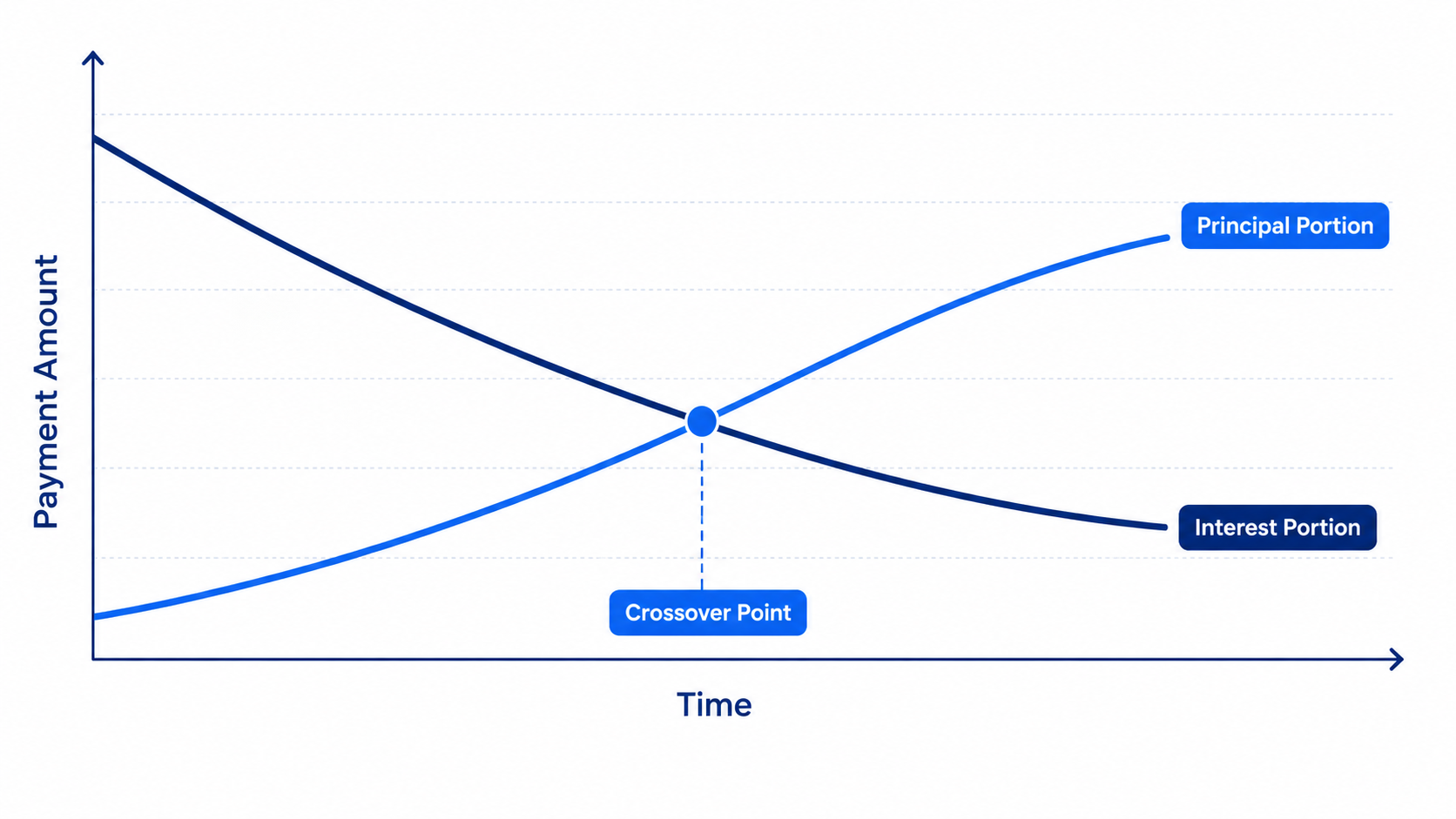
One of the most misunderstood aspects of amortization is how unevenly it treats interest and principal over time. Early payments are heavily interest front-loaded, meaning a large share goes toward interest rather than the balance itself.
This happens because interest is always calculated on the current remaining balance, and that balance is at its highest right after the loan begins. As the principal shrinks, the interest charged each period naturally shrinks alongside it.
Later in the loan, payments become principal back-loaded, with the majority of each payment finally reducing the actual amount borrowed. This shift does not happen suddenly; it unfolds gradually across the entire amortization curve.
Somewhere in the middle of a long-term loan sits the crossover point, the moment when more of the payment starts going toward principal than interest. Identifying this point helps borrowers understand their true payoff progress.
Comparing early payments vs late payments side by side makes the pattern obvious. The declining balance structure explains why the interest cost over time feels disproportionately front-loaded, especially on loans with longer original terms.
Amortization Across Different Loan Types
Personal loan amortization and student loan amortization each carry their own typical terms, rate ranges, and repayment expectations shaped by lender risk and borrower qualifications. Even so, every one of these products relies on the identical core formula.
Business loan amortization introduces additional complexity, since commercial lenders sometimes structure repayment around cash flow cycles rather than simple fixed months. Balloon structures and variable schedules appear far more often in business lending than in consumer lending.
Understanding fixed-rate vs adjustable-rate amortization matters across every loan category, not just mortgages. A fixed rate keeps the schedule predictable, while an adjustable rate introduces periodic recalculation that can shift payments significantly over time.
The following sections examine four common loan categories individually, highlighting what makes each one's amortization pattern distinct. Recognizing these differences helps borrowers interpret their own schedule with far greater context and confidence.
Mortgage Loans
Mortgages represent the longest and largest amortized debt most people ever take on. Choosing between a 30-year mortgage and a 15-year mortgage dramatically changes both the monthly payment size and the total interest paid.
A mortgage amortization schedule only reflects principal and interest, not the full monthly housing cost. Property taxes, homeowners insurance, and sometimes PMI get added separately, often bundled into a single escrow payment by the lender.
Fixed-Rate vs. Adjustable-Rate Amortization
A fixed-rate mortgage locks the interest rate for the entire term, giving borrowers fixed-rate stability and a completely predictable mortgage amortization schedule from the very first payment through the very last.
ARM amortization works differently. After an initial fixed period, a rate reset occurs, producing a recalculated schedule based on current market rates, which can raise or lower the monthly payment unpredictably going forward.
Auto Loans
Car loan amortization compresses the same repayment math into a much shorter window, typically between three and seven years. Shorter terms mean higher monthly payments but noticeably less total interest paid overall.
Auto loans also interact with vehicle depreciation in ways mortgages do not. A car loses value quickly, and combined with sales tax rolled into financing, some borrowers briefly owe more than the vehicle is worth.
Personal and Student Loans
Unsecured loan amortization applies to personal loans that are not backed by collateral like a home or vehicle. Because lenders take on more risk, personal loan term lengths and rates vary widely between borrowers.
A student loan repayment schedule often includes unique features not found in typical amortization products. Income-driven repayment plans, for example, adjust monthly payments based on earnings rather than a fixed formula alone.
Business and Commercial Loans
Business loan amortization frequently differs from consumer lending in structure and flexibility. A commercial loan schedule might be shorter than the amortization period used to calculate payments, creating an eventual large payoff requirement.
This mismatch often produces a balloon payment business loan, where regular payments are calculated as if the loan lasted longer than it actually does. The remaining balance becomes due in full once the shorter term ends.
Types of Loan Amortization (Beyond the Standard Schedule)
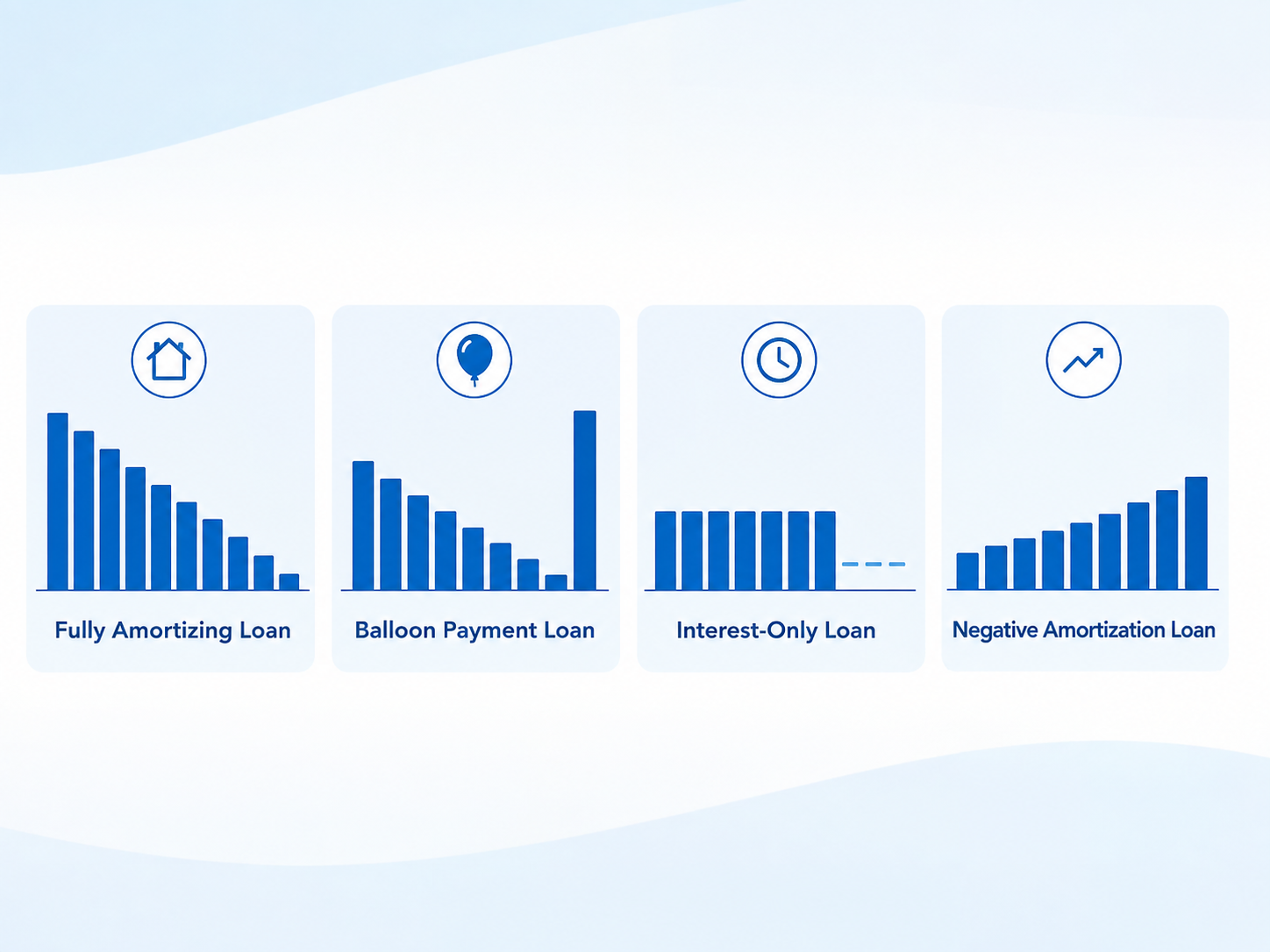
Not every loan follows the simple, predictable pattern described so far. A fully amortizing loan reaches a zero balance exactly on schedule, but several other structures exist, each behaving very differently over time.
A partially amortizing loan only pays down part of the principal through regular payments, leaving a portion due at the end. This creates a hybrid structure that borrowers must plan for well in advance.
Negative amortization describes a scenario where payments do not even cover accruing interest, causing the balance to grow instead of shrink. This structure carries real risk and deserves careful, informed attention from any borrower.
An interest-only loan temporarily suspends principal reduction entirely, while a balloon payment structure defers a large portion of principal until a single future date. Both differ significantly from the standard fully amortizing model.
Fully Amortizing Loans
A fully amortizing loan follows the standard repayment pattern most people picture when they think of a loan. Every payment includes both interest and principal, gradually shrinking the balance in a predictable, steady way.
Because the payment amount stays fixed, this structure guarantees the balance reaches zero exactly when the term ends, assuming no missed payments or rate changes interrupt the schedule along the way.
Balloon Loans
A balloon structure calculates monthly payments using a longer amortization period than the loan actually lasts. This produces smaller regular payments followed by one large final payment due at the end of the term.
Because the schedule is a shorter amortization term than payment schedule implies, borrowers must prepare in advance for that final lump sum, whether through savings, sale of the asset, or refinancing into a new loan.
Interest-Only Loans
During the interest-only period, monthly payments cover accrued interest exclusively, leaving the principal completely untouched. This keeps early payments noticeably lower than they would be under a standard fully amortizing structure.
Because principal is not reduced, the loan balance stays balanced unchanged throughout that introductory phase. Borrowers benefit from lower short-term costs but make no actual progress toward paying down what they originally borrowed.
Negative Amortization Loans
In a negative amortization structure, the unpaid interest added to balance each period means the borrower owes more after paying than before. This creates a growing loan balance instead of a shrinking one.
This typically happens under payment caps, where the minimum required payment is set below the actual interest accruing. The unpaid difference does not disappear; it gets added directly onto the principal owed.
How Extra Payments Affect Your Amortization Schedule
Making payments beyond the minimum required amount can meaningfully reshape a loan's trajectory. Extra principal payments reduce the balance faster than scheduled, which in turn reduces how much interest accrues in every future period.
Because interest is always calculated against the current balance, even modest interest savings compound over the remaining life of the loan. The earlier extra payments happen, the larger their cumulative effect tends to be.
A lump sum payment, such as an inheritance or year-end bonus, can dramatically shift a schedule when applied directly to principal. This single action can meaningfully shorten the remaining timeline of an otherwise long loan.
Borrowers pursuing a shortened loan term often combine several strategies at once: consistent extra monthly amounts alongside occasional lump sums. Together, these habits can help someone pay off loans early by a meaningful margin.
Making Lump-Sum or Extra Monthly Payments
A one-time extra payment applies a single amount directly to the principal, permanently reducing the balance used for all future interest calculations. This differs from simply paying ahead on a future scheduled payment.
An additional principal payment made consistently every month compounds over time, gradually accelerating the payoff date well beyond what a single lump sum alone could accomplish across the same repayment period.
Switching to Biweekly Payments
Instead of twelve monthly payments per year, a biweekly schedule results in 26 biweekly payments, each equal to half the standard monthly amount, spread across fifty-two weeks rather than twelve calendar months.
Because there are slightly more than fifty-two weeks in a year, this schedule naturally produces what is often called the 13th payment effect, an extra partial payment applied toward principal every year automatically.
What to Check Before Paying Extra (Prepayment Penalties)
Before committing to any accelerated payoff strategy, borrowers should confirm whether their loan includes a prepayment penalty. Some lenders charge a fee for paying off a loan faster than the originally scheduled term.
Getting lender approval or written confirmation in advance avoids unpleasant surprises. Not every loan allows unrestricted extra payments, and some contracts limit how much additional principal can be applied within a given year.
Loan Amortization and Your Taxes
Interest paid on certain amortized loans can carry tax implications, though these rules vary considerably depending on loan type and jurisdiction. The mortgage interest deduction remains one of the most widely discussed examples.
For qualifying homeowners, a portion of annual mortgage interest may be tax-deductible interest, though eligibility depends on factors like loan size, filing status, and whether the taxpayer itemizes deductions instead of taking a standard deduction.
Business owners may also encounter a business loan interest deduction, since interest on loans used for legitimate business purposes is often treated differently under tax law than interest on purely personal borrowing.
Understanding amortization for tax purposes sometimes requires looking beyond the simple payment schedule, since certain loan costs or fees may need to be spread out and deducted across multiple tax years instead of immediately.
Common Amortization Calculator Mistakes to Avoid
One frequent error involves confusing APR with interest rate, treating them as identical when they measure different things. APR includes certain fees and costs, while the interest rate alone only reflects the cost of borrowing itself.
Another common mistake involves ignoring extra fees entirely, assuming the calculator's output represents the full true cost of the loan. Origination charges, closing costs, and servicing fees often sit outside the basic amortization math.
Entering a wrong loan start date throws off every projected date in the schedule, including the final payoff date. Even a small date error can create confusion when comparing calculator output against actual statements later.
Entering a wrong loan start date throws off every projected date in the schedule, including the final payoff date. Even a small date error can create confusion when comparing calculator output against actual statements later.