
What Is Enterprise Value?
Enterprise value captures the total company value of a business, combining equity and debt into a single figure. It reflects what someone would actually pay to acquire the whole entire company, not merely its shares.
Unlike market capitalization, enterprise value is capital structure neutral. It treats debt and equity as different claims on the same underlying business, so two companies with different financing choices become directly comparable, side by side.
Analysts describe enterprise value as the theoretical takeover price because it reflects the cost to acquire a company. A buyer must pay off debt holders, absorb existing cash, and satisfy shareholders, all in one transaction.
This is why enterprise value matters far beyond textbooks. It gives investors, bankers, and executives a consistent lens for judging operating value of a company, independent of how that company happens to be financed today.
Because it accounts for equity and debt claims together, enterprise value offers a more holistic company worth than EV vs book value comparisons. It reflects the acquirer’s perspective, not just an accounting snapshot on paper.
Enterprise Value Formula
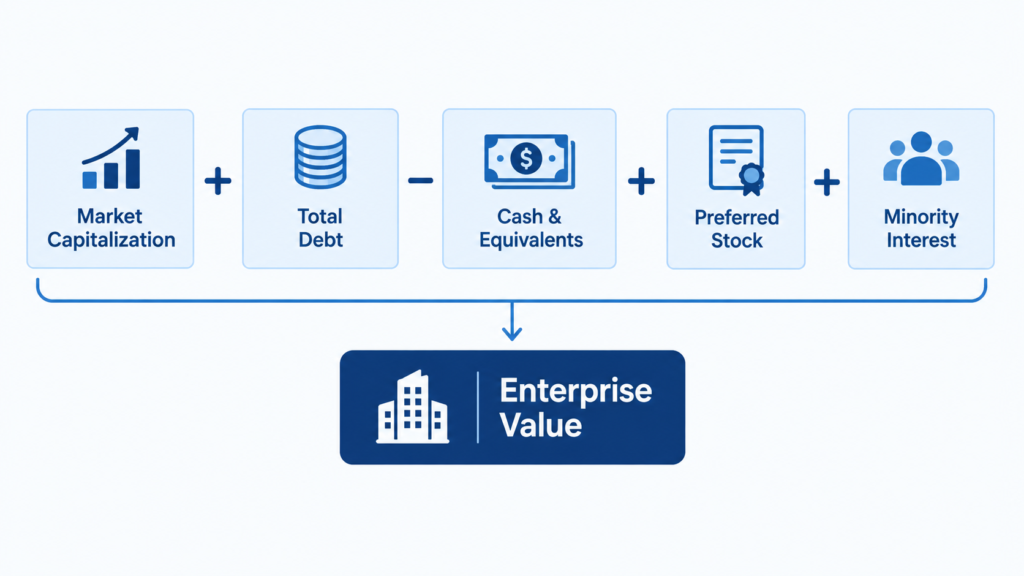
The EV formula combines several pieces of a company’s capital structure into one clear number. At its core, the enterprise value equation adds debt to equity value, then removes cash the company already holds today.
Written simply, the basic enterprise value formula is market capitalization plus debt minus cash. This captures the essential idea that owning a company means inheriting both its liabilities and its readily available liquid resources today.
The expanded enterprise value formula goes further. It reads EV = MC + Debt − Cash + Preferred Stock + Minority Interest, recognizing that some businesses carry additional claims beyond common debt and equity alone.
These components of EV are not arbitrary additions. Each one represents a real claim or resource that changes what an acquirer must actually pay, which is why formula variations exist across different company structures entirely.
Understanding these EV building blocks helps you choose between a simplified vs full formula depending on the company you are analyzing. Simple businesses rarely need every adjustment, while complex ones almost always do need them.
Basic Enterprise Value Formula
The simplified formula works well for a quick calculation across most public companies. It states that EV = market cap + total debt − cash, combining three figures pulled straight from a company’s public filings.
This short-form formula suits back of envelope EV work, like a fast screen across dozens of stocks at once. Analysts favor it early in a public company EV review, before diving into deeper adjustments later.
As a standard approach, the basic version assumes debt and cash are the only meaningful adjustments needed. For companies without preferred shares or subsidiaries, this minimal input version is often accurate enough on its own.
Full (Expanded) Enterprise Value Formula
A comprehensive EV formula accounts for preferred stock in EV and minority interest in EV, both of which represent real, legitimate claims beyond ordinary shareholders and lenders that any acquiring buyer must still fully satisfy.
Noncontrolling interest arises whenever a company owns part, but not all, of a subsidiary. Because financial statements consolidate the whole subsidiary, the adjusted enterprise value must still reflect the portion actually owned by outside investors.
Some analysts also treat operating leases as debt, alongside unfunded pension liabilities, associate company investments, and a non-operating asset subtraction, since these items shift what an acquirer truly inherits when actually buying an entire business.
Step-by-Step: How to Calculate Enterprise Value
Knowing how to calculate enterprise value step by step turns an abstract formula into a repeatable, dependable process. The EV calculation process always starts with gathering reliable financial data from trustworthy, current, verifiable public sources.
You will need to calculate market capitalization, then calculate net debt by finding total debt and subtracting cash on hand. These two figures form the foundation of nearly every enterprise value calculation, regardless of complexity.
From there, you may need to find total debt across several balance sheet lines, then find cash and equivalents separately, since public companies often split these figures across several reporting categories within one single filing.
Depending on the company, you might also add preferred stock and add minority interest to the running total. This EV calculation walkthrough becomes more thorough as a company’s capital structure grows increasingly complex over time.
Most of this balance sheet data for EV comes directly from 10-K financial statements, alongside current share price and shares outstanding figures. Building an EV worksheet helps keep every step organized and easy to check.
Step 1: Calculate Market Capitalization (Equity Value)
The market cap formula is straightforward: share price times shares outstanding. This gives you the current value the public market assigns to all outstanding common shares combined, forming the natural, logical starting point for EV.
However, diluted shares outstanding often differs meaningfully from the basic share count. The treasury stock method accounts for options and warrants dilution, estimating how many additional shares would exist if those instruments were exercised today.
Convertible securities dilution works similarly, since bonds or preferred shares that convert into common stock can meaningfully increase the outstanding shares figure. Using fully diluted equity value avoids understating the company’s true underlying overall size.
Step 2: Calculate Total Debt
Total debt on balance sheets typically includes both short-term debt and long-term debt, along with the current portion of long-term debt shown separately within many companies’ published annual financial statement presentations each fiscal reporting year.
Some interest-bearing liabilities are easy to miss, including capital leases as debt and other debt-like obligations buried deep in footnotes. Finding debt in 10-K filings often requires checking notes, not just the main balance sheet.
For most calculations, book value vs market value of debt rarely matters much, since debt trades closer to face value than equity typically does. A detailed debt schedule, when available, offers the clearest full picture.
Step 3: Subtract Cash and Cash Equivalents
The cash and equivalents definition includes currency, bank deposits, and highly liquid marketable securities that can convert to cash almost instantly. These items reduce the effective price an acquirer must ultimately pay for the business.
Why cash is subtracted comes down to logic: a buyer could use the target’s own cash to help fund the purchase. This is the essence of the broader net debt calculation used throughout valuation work.
Analysts should apply restricted cash exclusion carefully, since cash tied up for legal or operational reasons isn’t truly available. Distinguishing operating cash needs from excess cash treatment keeps the final liquid assets figure fully accurate.
Step 4: Add Preferred Stock
Preferred stock represents a senior claim on assets that ranks above common equity but below regular debt. Because it behaves like a preferred equity claim, it belongs inside the enterprise value calculation, not outside it.
Why preferred stock is added relates directly to its debt-like features. It typically carries fixed preferred dividends, similar to interest payments, which makes it function as preferred stock as debt-like in most practical, everyday situations.
Redeemable preferred stock and other forms of mezzanine financing sit between debt and equity on a company’s balance sheet. Treating this as a distinct non-common equity claim avoids underestimating the real total acquisition cost involved.
Step 5: Add Minority (Noncontrolling) Interest
Minority interest definition refers to the portion of a subsidiary not owned by the parent company. When consolidated subsidiaries appear on financial statements, their full value is included, even the portion owned externally by others.
Because of this, why minority interest is added becomes clear enough: the parent’s reported assets already include one hundred percent of the subsidiary, so the calculation must reflect that partial ownership stake accurately and fairly.
You’ll typically find noncontrolling interest on the balance sheet listed within equity, separate from the parent company’s own shareholders. This reflects subsidiary consolidation rules used consistently across most modern accounting standards applied by companies worldwide today.
Worked Example: Calculating Enterprise Value for a Real Company

Seeing an enterprise value example in action makes the formula far easier to apply with confidence. Imagine a hypothetical company built from sample balance sheet figures, drawn from a typical annual report EV calculation exercise.
Suppose the company has a market cap example of two billion dollars, based on its current share price multiplied by diluted shares outstanding. This becomes the equity value portion of our simple EV worked problem.
Next, assume a total debt example of five hundred million dollars, combining both short-term and long-term obligations together. Add a cash example of two hundred million dollars sitting openly on the balance sheet as reported.
Following the step by step numeric example, we calculate net debt first: five hundred million in debt, minus two hundred million in cash, leaving exactly three hundred million dollars from that net debt calculation result.
Plugging numbers into the EV formula, we get two billion plus three hundred million, totaling two point three billion dollars overall. This illustrative enterprise calculation shows how public company financial data becomes one clear valuation figure.
How to Calculate Enterprise Value for a Private Company
Calculating private company enterprise value is harder because there’s no public share price available to anchor the equity portion. Analysts must estimate value using alternative methods rather than simply reading it from a stock quote.
One common approach uses comparable company multiples, applying EV/EBITDA for private valuation based on similar public or recently sold businesses. This method borrows market-based logic even when valuing a private business directly and carefully today.
Another approach relies on discounted cash flow for EV, projecting future cash flows and discounting them back to present value. This method works especially well when reliable, detailed financial projections already exist for a business.
Estimating equity value privately sometimes uses revenue multiples private company analysis, especially for early-stage businesses without meaningful profits yet established. This approach appears often within private M&A valuation and broader business appraisal EV work generally.
The industry comps method and precedent transactions method both rely heavily on real-world deal data. Because private equity valuation approach work involves subjective judgment, results tend to vary more than typical illiquid company valuation estimates.
Common Mistakes When Calculating Enterprise Value
One frequent error involves using book value instead of market value for equity, which can badly distort the final results. Market prices reflect current investor expectations, while book value simply reflects older historical accounting entries.
Another common issue is forgetting restricted cash, treating all cash as freely available when some of it legally cannot be used at all. This creates inconsistent EV inputs that overstate how much cash offsets debt.
Double counting convertible debt happens when analysts include both the debt and its converted share equivalent together. Similarly, ignoring operating leases understates true obligations, since these behave like real debt under current accounting rules today.
Missing minority interest is a subtle but genuinely serious mistake, especially for companies with several partially owned subsidiaries. Using stale share price data or a wrong shares outstanding figure produces similarly unreliable, misleading results overall.
Finally, outdated debt figures and a mismatched numerator denominator in multiples create real accuracy issues within any analysis. Reviewing your calculation checklist errors carefully before finalizing any work helps avoid these entirely avoidable mistakes completely.
What Does Enterprise Value Tell You? (Interpreting the Result)
Interpreting enterprise value requires context, since the raw number alone rarely tells a complete story on its own. A high vs low enterprise value only becomes meaningful once compared against similar companies in one industry.
What a high EV means varies by situation. Sometimes it reflects genuine business size, while other times it signals heavy EV and leverage, where debt inflates the figure well beyond what equity alone would suggest.
Conversely, what a low EV means might indicate a smaller company, strong EV and financial risk management, or simply less overall capital intensity relative to peers operating within the same competitive market space and sector.
Thinking of EV as acquisition cost helps ground the number in practical reality. It represents what a buyer would actually pay today, making it genuinely useful for comparing EV across companies with different financing structures.
Because standalone EV number limitations exist, analysts always evaluate figures EV relative to industry peers. Benchmarking EV against sector averages, alongside other financial metrics, provides far more useful context within EV in context of financials.
Negative Enterprise Value: What It Means
A negative enterprise value explained simply means a company’s cash exceeds its market capitalization plus debt combined together. This unusual situation suggests the market values the business below its own net cash exceeding market cap.
This rare valuation scenario sometimes signals a cash-rich company trading at a steep discount, possibly due to market skepticism reasons like weak growth prospects, ongoing legal troubles, or broader industry-wide investor pessimism affecting market sentiment.
While negative EV examples occasionally reflect genuine bargains worth pursuing, they can also indicate deeper distressed company signals. Understanding these negative EV interpretation cases requires examining the underlying business closely, not just the raw number.
Enterprise Value vs. Equity Value vs. Market Capitalization

Comparing EV vs equity value starts with a fairly simple but important distinction. Equity value definition covers only what belongs to common shareholders, while enterprise value includes claims from both shareholders and lenders working together.
The difference between enterprise value and market cap matters because the market capitalization definition ignores debt entirely from the picture. Two companies with identical market caps can have different enterprise values once debt enters the picture.
Knowing when to use each metric avoids real confusion during everyday financial analysis work. Market cap suits pure equity questions, while enterprise value suits broader questions about the entire business, regardless of financing choices made.
This capital structure independence is precisely why comparing companies with different debt levels works better through enterprise value analysis. It creates an apples to apples comparison that market capitalization alone simply cannot provide reliably enough.
Because equity claims vs total firm claims differ fundamentally, converting equity value to EV and converting EV to equity value are truly essential skills. Together, they capture different stakeholder perspective differences across the whole business.
How Enterprise Value Is Used in Valuation Multiples
Valuation multiples explained simply: they compare a company’s value against some measure of its underlying financial performance. Because enterprise value covers the whole business, it pairs naturally with certain performance measures rather than others entirely.
The EV/EBITDA multiple, EV/EBIT multiple, EV/Revenue multiple, and EV/Sales ratio are the most common practical examples used in finance. Each one pairs enterprise value against a different measure of operating performance or overall business size.
Numerator denominator matching explains why these particular pairings matter so much. Since enterprise value belongs to both debt and equity holders together, its denominator must also reflect performance available to both groups, not shareholders alone.
This principle underlies most comparable company analysis, often simply called comps analysis in everyday practice. Because these multiples support genuine relative valuation, they remain central tools within industry benchmarking multiples applied across nearly every sector.
Because these ratios rely fundamentally on capital structure neutral multiples, that explains why EV multiples are used so widely today, especially throughout comps analysis and broader industry benchmarking multiples across differently financed companies worldwide today.
EV/EBITDA
The EV/EBITDA formula divides enterprise value by earnings before interest, taxes, depreciation, and amortization combined. This EV to EBITDA ratio strips out financing and accounting choices that can distort comparisons between otherwise similar companies significantly.
Why EV/EBITDA is popular comes down largely to consistency. It works well for comparing capital intensive businesses, since EBITDA as a proxy for cash flow removes distortions caused by different depreciation schedules or varying debt levels.
Analysts often reference industry average EV/EBITDA figures when interpreting EV/EBITDA multiple results carefully. Still, EV/EBITDA limitations exist, since normalized EBITDA adjustments can vary considerably, which matters greatly during EV/EBITDA in M&A deal negotiations and discussions.
EV/EBIT and EV/Revenue
The EV/EBIT formula includes depreciation and amortization effects, unlike EBITDA does, offering a slightly different view of underlying operating profitability. Meanwhile, the EV/Revenue formula ignores profitability entirely, focusing purely on total company sales generated instead.
Knowing when to use EV/EBIT versus when to use EV/Revenue depends heavily on the specific company type involved. Profitable, capital-heavy businesses often suit EV/EBIT best, while unprofitable ones need an entirely different lens applied instead.
EV/Sales use cases commonly include early stage company valuation, since unprofitable company valuation multiples need a metric that exists even before profits ever materialize. Choosing the right multiple always depends heavily on overall company maturity.
What Enterprise Value Is Used For
Among the many practical uses of enterprise value, mergers and acquisitions valuation stands out as the most direct and common application. It closely approximates the M&A takeover price a buyer would realistically need to offer.
Beyond simple deal-making, investment analysis with EV helps investors focus on comparing companies for investing across different industries and financing structures entirely. This supports more consistent risk assessment using EV throughout an entire investment portfolio.
Enterprise value also plays a role in leveraged buyout analysis, where capital structure risk becomes absolutely central to the transaction itself. Buyers evaluate how much debt a target company can realistically support relative to size.
In modeling work, EV in DCF terminal value calculations help translate projected cash flows into a present-day company value. This connects enterprise value calculation directly to broader EV in financial modeling practices used in finance.
Professionals rely on it constantly within EV in equity research, EV in company screening, and general everyday business decision making. These practical applications of EV support many different strategic valuation uses across the finance profession.
Limitations of Enterprise Value
Despite its clear usefulness, EV limitations are genuinely worth understanding well. Enterprise value excludes off balance sheet items that don’t appear within standard financial statements, potentially understating a company’s true underlying obligations or resources available.
It’s also genuinely hard to value private companies with EV, since reliable market prices and clean, audited financial disclosures simply don’t exist in the same consistent way they typically do for publicly traded businesses generally.
Notably, EV not suitable for financial institutions applies squarely to banks and EV exclusion, since debt as core business for banks makes typical debt adjustments essentially meaningless. Banks genuinely require entirely different valuation approaches instead.
Market cap volatility affecting EV creates a real snapshot in time limitation, since share prices shift constantly while balance sheet figures update far less frequently, creating awkward timing mismatches within any single calculation exercise performed.
Because EV doesn’t capture future cash flows directly, it remains a static metric limitation with real comparability issues across industries. Complementary metrics needed alongside it always, since EV alone is insufficient for truly complete analysis.
Frequently Asked Questions
What is the simplest formula to calculate enterprise value?
The simple EV formula is market cap plus debt minus cash, nothing more complicated than that. This basic enterprise value equation provides a quick EV calculation using only three commonly available figures from public filings.
Why do you subtract cash when calculating enterprise value?
Cash reduces acquisition cost because a buyer could theoretically use it immediately after completing the purchase. This reflects net debt logic, treating cash as a non-operating asset available from the acquirer’s perspective on cash specifically.
Why is minority interest added to enterprise value?
The minority interest addition reason relates to consolidated subsidiary claims on the balance sheet. Financial statements report full subsidiary value, so noncontrolling interest logic ensures the calculation reflects full firm value, not the parent’s portion.
Can enterprise value be negative?
Yes, a negative EV possibility genuinely exists when net cash exceeds market cap plus debt combined together. This negative enterprise value meaning appears in rare valuation cases, typically involving a distinctly cash-rich negative EV situation.
How do you calculate enterprise value for a private company?
Without a public stock price, analysts rely instead on comparable multiples valuation or DCF for private valuation methods. Estimating private equity value through either a private business valuation approach remains standard, accepted practice industry-wide today.
Is enterprise value the same as market capitalization?
No, they are different. The EV vs market cap difference is significant, since market cap reflects equity value only, while enterprise value offers a broader total firm value comparison, explaining why EV is broader overall.
What is a good enterprise value?
There’s no universal good EV benchmark, since typical size varies enormously across different sectors and industries. Any industry comparison EV must remain context dependent, following a relative valuation standard rather than any one fixed number.
How is enterprise value used in EV/EBITDA?
The EV/EBITDA calculation use applies enterprise value as the numerator against underlying operating earnings figures. This valuation multiple application supports capital structure neutral comparisons within the broader comps analysis usage applied across an entire industry.
Does enterprise value include operating leases?
Under modern accounting rules, operating leases as debt often get included, reflecting the ASC 842 impact on EV calculations. These lease liabilities in EV represent modern accounting adjustments for genuinely real, ongoing debt-like lease obligations.
How do you convert enterprise value back to equity value?
The EV to equity value bridge works in reverse: subtracting debt and adding cash returns you to equity value. This reverse enterprise value calculation proves especially useful within a typical LBO equity value calculation exercise.