
What Is Business Valuation?
Business valuation is the structured process of estimating the true economic value of a company at a specific point in time, based on documented evidence rather than guesswork or emotional attachment to the business itself.
Every valuation depends heavily on a clearly defined valuation date, because a company’s worth shifts constantly with revenue swings, market conditions, competitive pressure, and internal operating performance over even short stretches of time, in practice.
Most valuations treat a business as a going concern, meaning it will keep operating and generating steady income into the future, rather than being shut down and sold off piece by piece immediately, in practice.
Fair market value differs sharply from book value. Book value reflects historical accounting entries recorded on a balance sheet, while fair market value reflects what a genuinely willing buyer would actually pay a willing seller.
A qualified business appraiser blends detailed financial data, relevant industry benchmarks, and careful professional judgment into a formal valuation report, giving owners, investors, and courts a defensible, well-supported estimate of overall business worth, in practice.
Why Businesses Get Valued (And Why the Purpose Changes the Number)
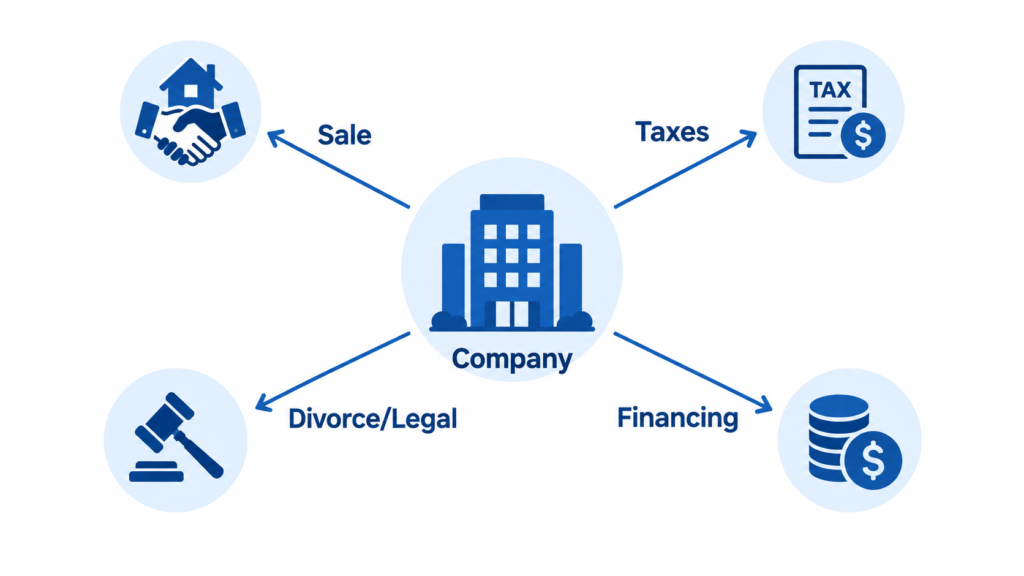
The reasons for pursuing a business valuation vary widely across owners, and the purpose behind the request often changes the final number more than the underlying financial performance of the company being examined actually does.
A sale negotiation, a pending merger and acquisition deal, and an estate and gift tax filing can each demand a different standard of value, even when carefully examining the same company on the same date.
Fair market value assumes a hypothetical, reasonably informed buyer and seller acting freely. Investment value, by contrast, reflects what the business is specifically worth to one particular buyer, shaped by unique synergies or strategic goals.
A control interest in a company is typically worth considerably more per share than a minority interest, because control brings the power to set direction, hire management, and decide when to eventually sell, in practice.
Understanding clearly why the valuation is needed, before any numbers get calculated, helps owners and appraisers choose the right method, apply appropriate discounts, and avoid producing a mismatched, misleading final figure for everyone involved, overall.
Valuation for Selling or Merging a Business
When an owner plans an eventual exit, a business sale valuation anchors early price negotiations and helps both sides agree on realistic terms before any legal paperwork or due diligence formally begins, in most cases.
M&A valuation work often looks well beyond historical earnings alone, weighing deal structuring, operational synergies, and strategic fit, since a buyer may gladly pay a premium for capabilities it cannot easily build internally, in practice.
The willing buyer, willing seller standard assumes neither party is under undue pressure, both have reasonable knowledge of the business, and the resulting transactional value reflects a genuinely fair, arms-length exchange between informed parties, overall.
Valuation for Tax and Estate Planning
Estate tax valuation and gift tax valuation both require strict, thorough documentation, because tax authorities scrutinize these submitted figures closely and can challenge any numbers that appear unreasonably inflated or artificially reduced, in most cases.
The IRS valuation requirements generally call for the fair market value standard, applied consistently across the entire process and supported by a defensible methodology that any trained reviewer could independently replicate and verify, in practice.
Succession planning valuation work often stretches well beyond producing a single number, helping families thoughtfully structure ownership transfers, minimize unnecessary tax exposure, and preserve the business smoothly across multiple future generations, for most business owners.
Valuation for Divorce, Litigation, and Partner Disputes
A marital business valuation frequently becomes contentious during divorce proceedings, since each spouse may hire a separate appraiser and produce meaningfully different conclusions about the exact same underlying company and its assets, in most cases.
Shareholder dispute valuation cases often hinge directly on a buy-sell agreement trigger, a pre-written contract clause that predetermines how ownership interests get priced whenever a partner exits, retires, or unexpectedly passes away, in most cases.
Courts weighing equitable distribution typically rely on independent appraisers to separate personal goodwill from enterprise goodwill, since only the latter category usually counts as a divisible marital asset under most state laws, in most cases.
Valuation for Financing, Insurance, or Internal Planning
Lenders reviewing a loan collateral valuation want a conservative, clearly defensible number, since the business itself may eventually need to be sold if the borrower ultimately defaults on the outstanding loan repayment, in most cases.
Key person insurance valuation carefully estimates the financial damage a company would suffer if a critical founder, executive, or specialist suddenly left through death, disability, or unexpected resignation from the business, for most business owners.
ESOP feasibility studies and internal strategic planning valuation work help owners track meaningful progress, set realistic incentive targets, and understand whether the company can genuinely support an employee ownership transition over time, in most cases.
The Three Core Approaches to Business Valuation
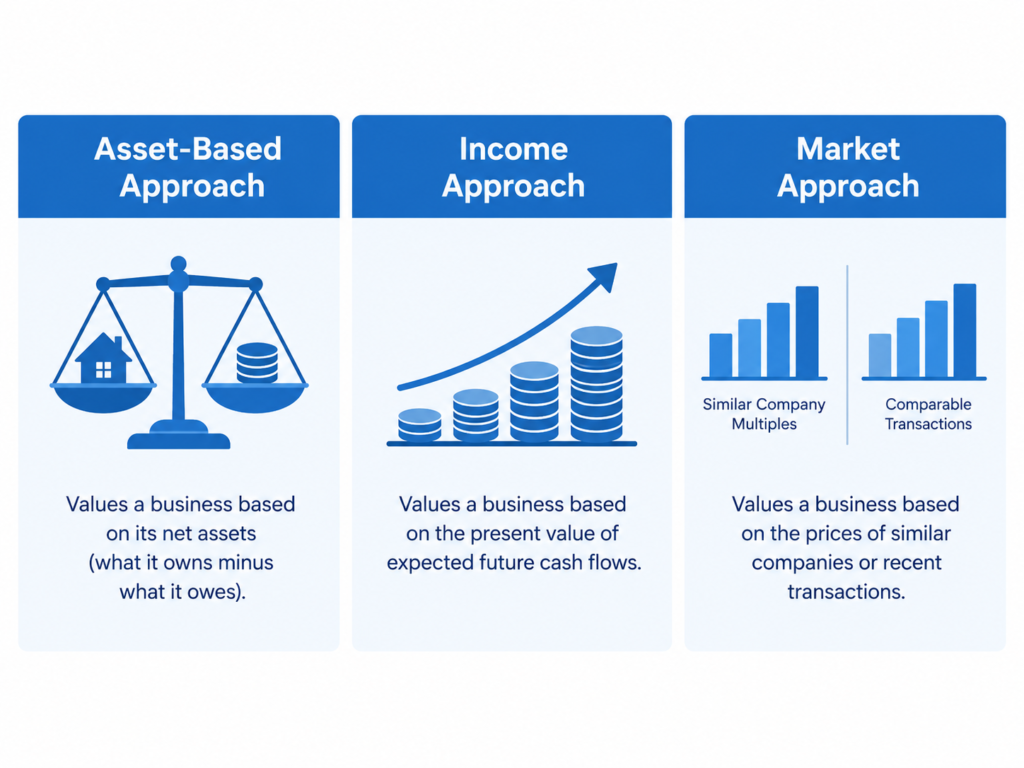
Professional appraisers generally rely on three well-established approaches: the asset-based approach, the income approach, and the market approach, each one answering a fundamentally different underlying question about a company’s total worth, for most business owners.
No single approach works perfectly for every type of business, which is why experienced appraisers often calculate two or three methods separately, then reconcile the differing results into one final supported figure, in most cases.
The asset-based approach suits companies holding significant tangible assets particularly well, since it essentially totals everything the business currently owns and subtracts everything the business currently owes to outside parties, when reviewed carefully over time.
The income approach suits companies driven mainly by future earning power, systematically converting projected cash flow into a present value using a carefully selected and well-justified discount rate for the calculation, for most business owners.
The market approach compares the subject company directly against similar businesses that recently sold or actively trade publicly, translating real observed transaction data into applicable, industry-specific pricing multiples for comparison, when reviewed carefully over time.
Asset-Based Approach
The net asset value method starts with a company’s existing balance sheet, then carefully adjusts every asset and liability to reflect current market conditions rather than outdated historical accounting cost figures, for most business owners.
An adjusted net asset method recalculates real estate, equipment, and inventory at present-day fair value, since original purchase prices rarely match what those specific assets are genuinely worth in today’s market, for most business owners.
This particular approach fits asset-heavy business valuation scenarios especially well, such as manufacturers or real estate holding companies, but it often understates the value of service-based or intellectual-property-driven businesses considerably, when reviewed carefully over time.
Income Approach
The discounted cash flow method carefully projects future cash flows over several upcoming years, then discounts each of them back to today’s dollars using the weighted average cost of capital or a similarly derived rate.
Capitalization of earnings works somewhat differently, converting one single normalized, sustainable earnings figure into overall value using just one capitalization rate instead of multiple detailed future projections spread over time, when reviewed carefully over time.
A terminal value calculation captures everything a business is realistically expected to earn beyond the explicit forecast period, and it often represents a surprisingly large share of the total DCF valuation figure, in most cases.
Market Approach
Comparable company analysis carefully examines publicly traded businesses operating in the same industry, extracting useful pricing multiples like the EBITDA multiple or revenue multiple for meaningful, apples-to-apples comparison purposes, for anyone working through this process.
The guideline public company method and precedent transactions method both rely heavily on real market data, though private company sale prices are notably harder to research than actively traded public prices, for most business owners.
Small businesses often use an SDE multiple instead of these larger measures, since owner-operated companies rarely generate the same scale of EBITDA that larger, professionally managed businesses typically produce and publicly report, in most cases.
Common Business Valuation Formulas and Methods, Explained
Turning valuation theory into an actual usable number requires applying a specific business valuation formula, matched carefully to the company’s overall size, industry, and the available financial documentation on hand, when reviewed carefully over time.
The book value formula and market capitalization formula work only for fairly straightforward situations, while the discounted cash flow formula demands considerably more data, effort, and careful analytical judgment throughout the process, in most cases.
Each formula ultimately answers a slightly different underlying question, so choosing the wrong one can still produce a technically correct calculation that nonetheless misrepresents the company’s actual real-world worth, for anyone working through this process.
A concrete, real-world valuation example helps clarify exactly how these abstract formulas translate into practical numbers, showing precisely how each individual input changes the final calculated outcome and result, for anyone working through this process.
Learning how to calculate business value step by step gives owners a much clearer, more grounded, and more confident sense of what actually drives their company’s number up or down, when reviewed carefully over time.
Book Value Method
The book value formula simply subtracts total recorded liabilities from total recorded assets, using figures pulled directly from the company’s most recent official balance sheet statement, which is a point worth remembering throughout the process.
This balance sheet valuation approach ignores goodwill, brand strength, and future earning potential entirely, which makes it a fairly weak standalone method for most actively operating companies today, which matters more than owners often realize.
Book value works best merely as a floor estimate, showing the absolute minimum value a business would theoretically retain if it were liquidated immediately at recorded book prices, which matters more than owners often realize.
Market Capitalization Method
The market cap formula simply multiplies current share price times shares outstanding, producing an instant, easily verifiable value for any actively traded public company on the market, and this detail should not be overlooked lightly.
This particular method only applies to public company valuation, since private businesses have no continuously traded share price figure that can be plugged directly into the formula, and this detail should not be overlooked lightly.
Market capitalization can swing quite sharply with shifting investor sentiment, meaning it sometimes reflects short-term market mood rather than the company’s genuine underlying long-term business fundamentals, which is a point worth remembering throughout the process.
Discounted Cash Flow (DCF) Method
The DCF formula systematically discounts each year’s projected free cash flow back to present value, then carefully sums every discounted year together into one total combined figure, and this detail should not be overlooked lightly.
Discount rate selection matters enormously throughout this process, since even small changes to the assumed rate can swing the final calculated valuation by a fairly substantial margin, and this detail should not be overlooked lightly.
The terminal value calculation typically covers all cash flows extending beyond the explicit forecast period, and it frequently represents the majority of the total present value figure, and this detail should not be overlooked lightly.
Capitalization of Earnings Method
The cap rate formula simply divides one representative year of normalized earnings by a carefully chosen capitalization rate, producing a value without projecting multiple separate future years individually, which matters more than owners often realize.
This single-period earnings valuation approach suits stable, mature companies with fairly predictable performance, but it suits fast-growing or highly volatile businesses considerably less effectively overall, and this remains true across nearly every industry and situation.
Selecting an appropriate capitalization rate genuinely requires sound judgment about risk, realistic growth expectations, and how reliably the company’s earnings are likely to continue going forward, which is a point worth remembering throughout the process.
Excess Earnings Method
The excess earnings formula carefully separates a company’s total return into two distinct parts: earnings generated on tangible assets and earnings attributable specifically to goodwill above that established baseline, for anyone working through this process.
It first calculates a normal rate of return on net tangible assets, then treats anything earned beyond that established baseline as the goodwill valuation component of total value, which matters more than owners often realize.
This particular method suits small, owner-operated businesses especially well, where intangible reputation and long-standing customer relationships genuinely drive a meaningful share of total overall profitability, and this remains true across nearly every industry and situation.
Times Revenue / EBITDA Multiple Method
The times revenue method simply multiplies annual sales figures by an industry-appropriate factor, offering a fast rough estimate whenever profit figures are unreliable, incomplete, or simply unavailable, and this detail should not be overlooked lightly.
The EBITDA multiple by industry varies quite considerably, since capital-intensive sectors typically trade at noticeably different multiples than asset-light, high-margin service businesses with different cost structures, and this remains true across nearly every industry and situation.
For very small companies specifically, an SDE multiple applied directly to owner earnings often produces a more realistic and defensible comparable transaction multiple result than alternatives, which is a point worth remembering throughout the process.
Normalizing Earnings: The Step Most Guides Skip
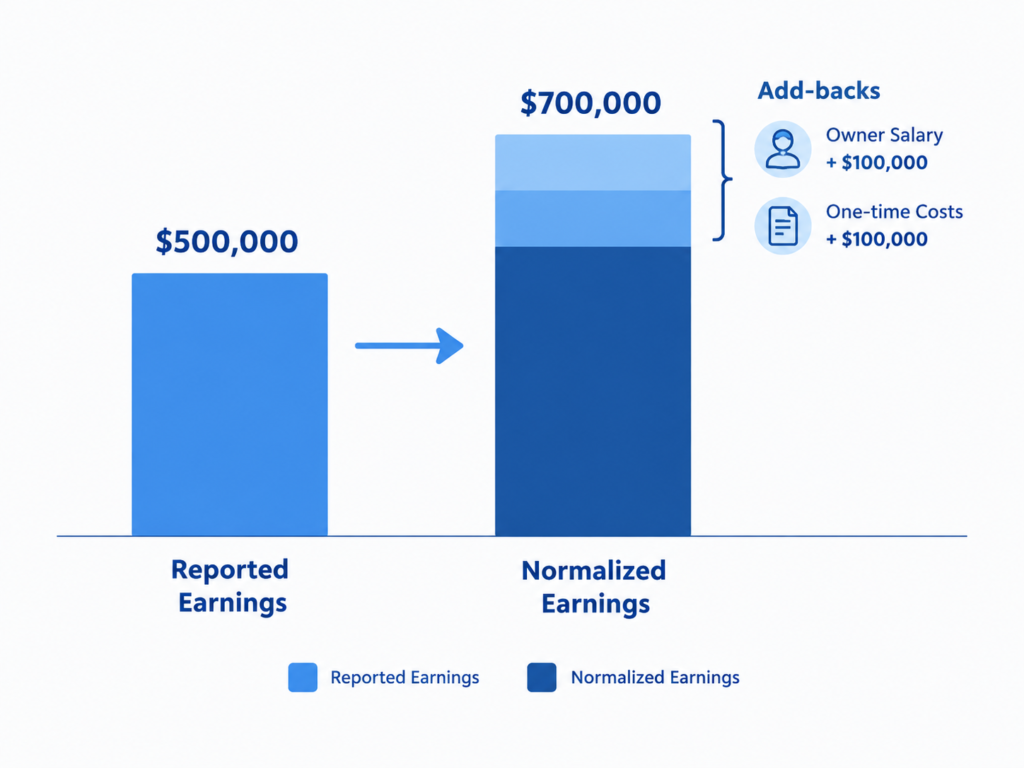
Earnings normalization carefully adjusts a company’s reported profit to reflect its true, ongoing earning power, systematically removing distortions that would otherwise mislead a prospective buyer or professional appraiser, which matters more than owners often realize.
Owner add-backs represent the most common adjustment made, since many small business owners routinely run personal expenses through the company or take compensation well above genuine market rates, which matters more than owners often realize.
One-time expense adjustments remove unusual, non-recurring costs like lawsuit settlements, relocation expenses, or storm damage repairs that will realistically not recur in future operating years ahead, which is a point worth remembering throughout the process.
A related-party rent adjustment corrects situations where an owner charges the business above or below fair market rent for property that they personally happen to own, which is a point worth remembering throughout the process.
The resulting adjusted EBITDA or normalized net income figure represents the company’s genuine true earning power, forming the essential foundation for nearly every income-based valuation method used, and this detail should not be overlooked lightly.
Valuation Discounts and Premiums That Change the Final Number
A calculated value rarely stands alone as the final number, because appraisers routinely apply additional discounts and premiums tied directly to ownership structure and overall liquidity considerations, and this detail should not be overlooked lightly.
A marketability discount, often simply called DLOM, reduces value because private company shares cannot be quickly sold or converted to cash, unlike shares of a publicly traded company, which matters more than owners often realize.
A discount for lack of control, or DLOC, applies specifically when the interest being valued cannot direct company strategy, distributions, or any other major business decisions, which is a point worth remembering throughout the process.
Conversely, a control premium increases overall value when the interest being examined can genuinely direct the company, reflecting the added power that majority ownership meaningfully provides its holder, which matters more than owners often realize.
These adjustments depend heavily on the specific level of value being measured, so appraisers must clearly identify whether they are valuing a controlling interest or a minority interest, which matters more than owners often realize.
Key Factors That Affect What a Business Is Worth
Factors affecting business value extend well beyond raw financial statements alone, touching everything from customer relationships to exactly how deeply the owner is embedded in daily operations, and this detail should not be overlooked lightly.
Strong revenue growth paired with genuinely healthy profit margins signals a company capable of generating consistently increasing returns, which buyers and appraisers both reward generously with higher applied multiples, for anyone working through this process.
Customer concentration risk worries prospective buyers considerably, since losing one dominant client can devastate revenue almost overnight in ways diversified customer bases simply cannot realistically experience, which is a point worth remembering throughout the process.
Intangible assets, including goodwill, brand value, and stable recurring revenue streams, often separate an average, ordinary business from a genuinely premium, highly sought acquisition target for buyers, and this detail should not be overlooked lightly.
Owner dependency remains one of the most consistently underestimated risks, since a business that cannot function without its founder present is inherently much harder to sell or scale, which matters more than owners often realize.
How to Calculate Your Business’s Value: A Step-by-Step Walkthrough
Learning how to value a business step by step turns an otherwise intimidating exercise into a manageable, repeatable process that any motivated owner can reasonably follow from start to finish, when reviewed carefully over time.
This small business valuation process works best when owners set aside genuinely dedicated time, gather accurate financial records, and resist the natural urge to rush toward one final number, for anyone working through this process.
Each step outlined below builds directly on the one immediately before it, so skipping steps or reordering them tends to produce a noticeably weaker, less defensible final estimate, which matters more than owners often realize.
Owners who carefully follow this valuation checklist typically arrive at a far more credible and trustworthy number than those relying purely on informal rules of thumb, which is a point worth remembering throughout the process.
Treat this entire walkthrough as a genuine DIY business valuation starting point, not as a replacement for a certified appraisal whenever high-stakes decisions are actually involved, which is a point worth remembering throughout the process.
Step 1: Gather Your Financial Statements
Start by carefully collecting the profit and loss statement, balance sheet, and cash flow statement for at least the past three complete fiscal years available, and this remains true across nearly every industry and situation.
Lenders, buyers, and professional appraisers all expect to see three years of financials, since a single isolated year rarely reveals whether performance is genuinely stable or steadily improving over time, when reviewed carefully over time.
Pull matching tax returns alongside these financial statements, since any discrepancies between internal records and officially filed returns raise immediate credibility concerns during formal due diligence, which is a point worth remembering throughout the process.
Step 2: Normalize Your Earnings
Apply appropriate add-backs for above-market owner compensation, personal expenses run improperly through the business, and any genuinely unusual one-time costs incurred during the recent past, and this remains true across nearly every industry and situation.
This important step reveals what the business would realistically earn under a professional management structure, rather than strictly under its current owner’s own specific financial arrangement and habits, which matters more than owners often realize.
Skipping normalization entirely is one of the most common reasons valuations end up either significantly overstated or unfairly understated compared to the company’s true performance, and this remains true across nearly every industry and situation.
Step 3: Choose the Right Valuation Method for Your Business
Matching method to business type matters enormously here, since an asset-heavy manufacturer and a subscription software company genuinely require fundamentally different valuation approaches to reach an accurate number, which matters more than owners often realize.
Consider carefully whether your company is asset-heavy or earnings-driven in nature, since that basic distinction largely determines whether an asset-based or income approach ultimately fits better, which is a point worth remembering throughout the process.
Look specifically for an industry-appropriate method already commonly used by appraisers and buyers within your particular sector, since consistency meaningfully improves credibility during eventual negotiations, and this remains true across nearly every industry and situation.
Step 4: Apply the Formula and Calculate a Range
Rather than forcing one single exact number, calculate a reasonable valuation range spanning conservative, moderate, and genuinely optimistic assumptions about the company’s likely future performance, and this remains true across nearly every industry and situation.
Present a clear low-mid-high estimate to interested stakeholders, since business valuation is inherently an informed estimate, not a precise or universally agreed scientific measurement of worth, which is a point worth remembering throughout the process.
Run a simple sensitivity check by adjusting several key assumptions slightly, then carefully observing how much the final range shifts in direct response to each individual change, and this detail should not be overlooked lightly.
Step 5: Sanity-Check Against Market Comparables
Compare your calculated range carefully against industry benchmark multiples published by trade associations, experienced business brokers, or specialized valuation data providers within your sector, since this step builds genuine confidence in the final calculated number.
Research recent comparable sale prices for genuinely similar businesses, adjusting thoughtfully for differences in overall size, location, growth rate, and business risk profile, which is why careful preparation tends to pay off in the end.
This final reality check step reliably catches calculation errors and unrealistic assumptions before the finished number gets presented to buyers, lenders, or courts, which is why careful preparation tends to pay off in the end.
DIY Estimate vs. Professional Business Appraisal: Which Do You Need?
A DIY business valuation works reasonably well for internal planning purposes, informal negotiations, or simply understanding roughly where a business currently stands financially at a glance, which is a point worth remembering throughout the process.
A certified business appraiser becomes genuinely essential once the valuation supports litigation, formal tax filings, or any legal proceeding where the resulting number faces meaningful outside scrutiny, and this detail should not be overlooked lightly.
Credentials like ABV, CVA, and ASA clearly signal that an appraiser has passed rigorous formal training and consistently follows recognized professional valuation standards throughout their work, which is a point worth remembering throughout the process.
Valuation for legal purposes almost always requires a formal, credentialed appraisal, since courts and tax authorities rarely accept an informal estimate as sufficient supporting evidence, and this remains true across nearly every industry and situation.
Weighing the cost of a professional valuation against a simple valuation calculator estimate ultimately depends on how much is financially or legally riding on the final outcome, and this detail should not be overlooked lightly.
Common Business Valuation Mistakes to Avoid
Overvaluing a business is remarkably common among owners, since they naturally attach deep emotional significance to a company they personally built, sacrificed for, and grew over many years, which matters more than owners often realize.
Ignoring normalized earnings distorts the entire calculation from the very first step onward, since every subsequent formula ultimately depends on an accurate underlying profit figure to start, and this detail should not be overlooked lightly.
Choosing the wrong valuation method for a company’s actual structure produces a technically calculated yet fundamentally misleading final number for anyone making decisions, which is why careful preparation tends to pay off in the end.
Relying on rules of thumb without genuine supporting comparable data ignores meaningful differences between businesses that superficially look similar but actually perform very differently in practice, which is a point worth remembering throughout the process.
Using outdated financials or simply forgetting to apply appropriate discounts are two frequent valuation red flags that experienced buyers and appraisers tend to notice almost immediately, which is a point worth remembering throughout the process.
Frequently Asked Questions
What is the easiest way to calculate the value of a small business?
Applying an SDE multiple to a seller’s discretionary earnings offers the simplest and fastest small business rule of thumb, using an industry-specific multiple to reach a rough estimate quickly, which matters more than owners often realize.
What is a good multiple to value a business?
There is no single universal multiple that applies everywhere; industry-specific multiples vary widely, so researching typical EBITDA multiple range or revenue multiple range figures for your specific sector matters most, when reviewed carefully over time.
How much is a business worth with $1 million in revenue?
Value depends entirely on profit margins and relevant industry benchmarks, since a revenue multiple example applied to weak margins produces a very different result compared to genuinely strong ones, for anyone working through this process.
What’s the difference between business valuation and business appraisal?
Valuation is the broader concept of carefully estimating overall worth, while an appraisal typically refers to a formal, credentialed process that produces a documented, defensible written valuation report, which matters more than owners often realize.
How often should a business be valued?
Many owners pursue an annual valuation or some periodic review, though specific triggering events like a partnership change, a sale, or a divorce often prompt an immediate reassessment instead, for anyone working through this process.
Does business valuation include debt?
Enterprise value represents the entire operating business as a whole, while equity value reflects what remains for owners after a net debt adjustment, so these two figures genuinely differ, for anyone working through this process.
Can I value my own business without hiring a professional?
A DIY valuation works reasonably well for informal purposes, but self-valuation accuracy tends to fall noticeably short whenever legal, tax, or genuinely high-stakes negotiation outcomes depend on the result, for anyone working through this process.
How does goodwill affect business valuation?
Goodwill valuation carefully captures intangible asset value like reputation and long-standing customer loyalty, often calculated through the excess earnings method described earlier in detail within this guide, and this detail should not be overlooked lightly.
What documents do I need for a business valuation?
Gather the financial statements needed covering several recent years, current tax returns, an updated cap table, key customer contracts, and a detailed, itemized asset list, and this remains true across nearly every industry and situation.
Why did my business valuation come in lower than expected?
Common culprits include unapplied valuation discounts, elevated customer concentration risk, unnormalized earnings, genuinely weak comparables, or a significant owner dependency discount meaningfully affecting the final calculated number, and this detail should not be overlooked lightly.