
What Is Company Valuation and Why Method Choice Matters
Company valuation is the structured process of estimating what a business is truly worth today. Analysts, owners, and investors rely on established valuation methods to reach a defensible, well-supported number instead of a rough guess.
The goal is usually fair market value or intrinsic value, depending on the situation. Fair market value reflects what a willing buyer would reasonably pay a willing seller. Intrinsic value reflects the company’s underlying economic worth, independent of short-term market sentiment.
Why value a company in the first place? Owners often need numbers for fundraising valuation rounds, partnership buyouts, succession planning, or internal strategic decisions. Investors need reliable figures to judge whether a stock trades above or below true worth.
Valuation purpose shapes which specific method fits best in any given scenario. A mergers and acquisitions valuation looks quite different from a tax valuation, a valuation for sale, or one prepared for shareholder disputes and estate planning valuation filings.
Valuation accuracy depends heavily on valuation context, more than most people realize at first. The same business can carry very different values depending on the reason for the exercise, the intended audience, and the underlying assumptions built into each method.
The Three Core Approaches to Company Valuation
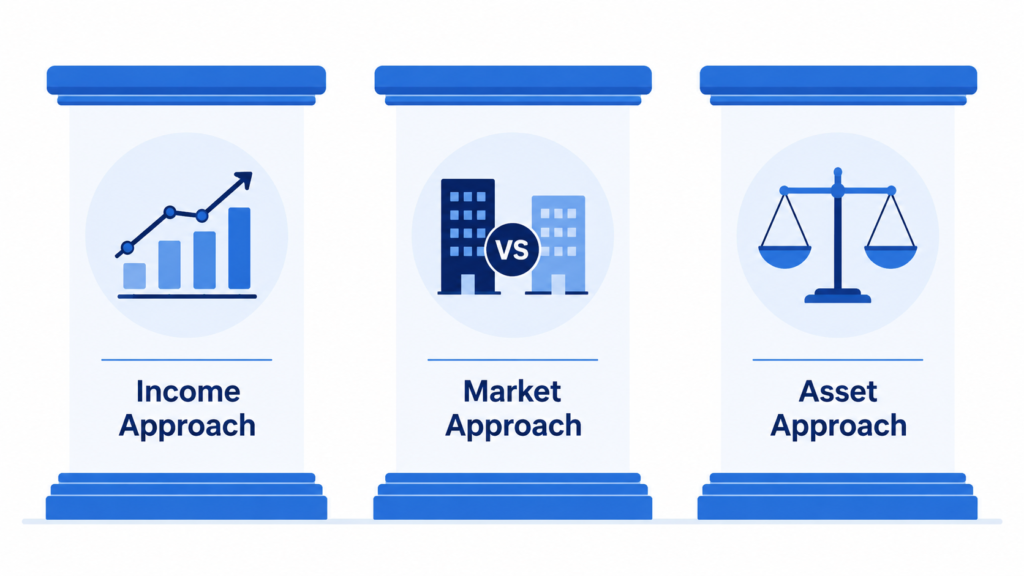
Every recognized valuation method used in practice falls under one of three broad categories. Understanding this valuation framework first makes the individual techniques discussed later in this guide far easier to follow and apply correctly.
The income approach, market approach, and asset-based approach together form the primary valuation approaches used worldwide by analysts, appraisers, and investors. Each one answers the “what is this company worth” question from a distinct analytical angle.
It helps to separate valuation approach vs method early in the discussion. An approach is a broad philosophy for thinking about worth; a method is the specific calculation performed underneath that philosophy, using defined inputs and formulas.
Income-based valuation looks forward, estimating future cash generation and earning power. Market-based valuation looks sideways, comparing the company against similar businesses already priced by the market. Asset-based valuation looks squarely at what the company owns.
Approach selection criteria typically include industry type, data availability, company maturity, and the valuation’s underlying purpose. This brief valuation approach overview sets the stage before the guide breaks down each valuation methodology category into practical, usable, repeatable methods.
Income Approach
The income approach values a company based on its expected future earnings or cash flow. It converts projected profits into a single present-day figure by applying an appropriate discount rate throughout.
This is fundamentally a future earnings valuation technique built on forward-looking assumptions. Analysts favor cash flow based valuation because it reflects a company’s true earning capacity, rather than relying solely on historical accounting figures or comparisons.
When to use income approach methods: profitable, cash-generating businesses with reasonably predictable operations and stable industry conditions. Income approach pros and cons include strong theoretical grounding, balanced against real income approach limitations like heavy reliance on projection accuracy.
Market Approach
The market approach definition centers on direct comparison rather than forward projection. It estimates value by examining what genuinely similar companies sold for, or currently trade for, in the open market.
Comparable valuation and relative valuation serve as the working tools of this entire approach. Analysts identify a suitable peer group, extract pricing multiples from those peers, and apply them to the target company’s own financial figures.
When to use market approach techniques: industries with abundant public data, frequent transactions, and reasonably comparable competitors available for reference. Market approach pros and cons balance real-world grounding against notable market approach limitations, including imperfect peer comparability and shifting market sentiment.
Asset-Based Approach
The asset-based approach values a company by totaling its assets and then subtracting outstanding liabilities. It suits asset-heavy businesses far more than service-based firms built mainly on intangible earning power and reputation.
This method carefully distinguishes between liquidation basis and going concern basis assumptions throughout the calculation process. Net asset value under liquidation basis assumes a forced, rapid sale, while going concern basis assumes continued normal, ongoing operations.
When to use asset approach methods: holding companies, real estate firms, investment vehicles, or businesses actively facing closure or restructuring. Asset approach pros and cons weigh simplicity against real asset approach limitations, since it often ignores future earning potential.
Income Approach Methods, Explained
Income approach methods translate the broad future-earnings philosophy into concrete, repeatable, well-documented calculations. Each individual technique converts projected financial performance into a present value figure using accepted income approach formulas.
The most widely used income-based valuation techniques include discounted cash flow, capitalization of earnings, and the dividend discount model. Each technique suits different company profiles, growth patterns, industries, and levels of data availability.
The present value of future earnings sits at the very core of every technique discussed in this section. Analysts estimate future cash flow or income, then discount it back to today using a chosen discount rate.
An income multiplier method and free cash flow valuation both clearly belong to this same broader family of techniques. They differ mainly in whether they use earnings, dividends, or actual cash flow as the primary calculation input.
Every earnings-based valuation technique must eventually address terminal value, the estimated worth of the business beyond its explicit forecast period. This single figure often carries the majority of total valuation weight in the final estimate.
Discounted Cash Flow (DCF) Analysis
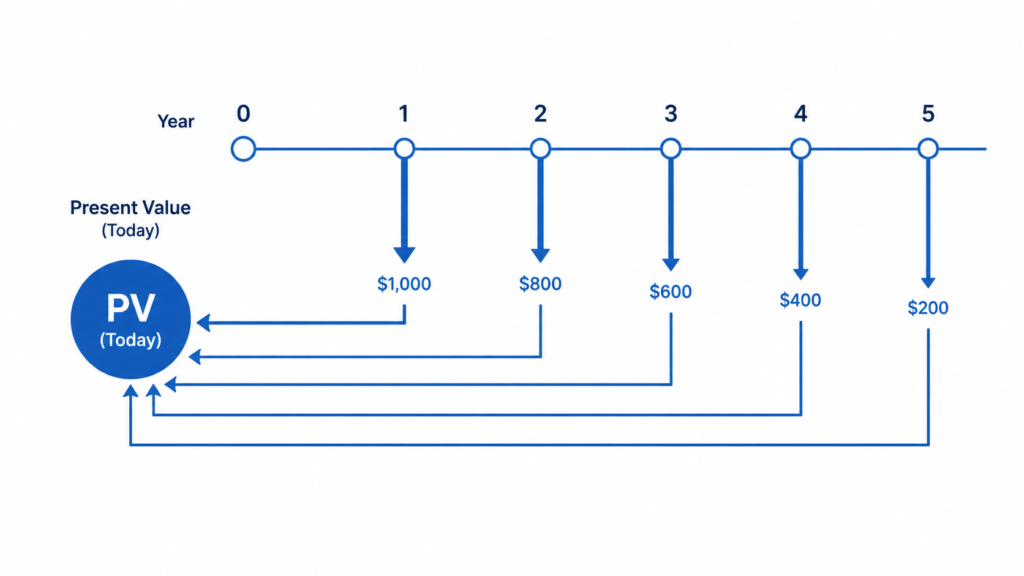
The DCF method projects a company’s future free cash flows across several years, then discounts them back to present value using a defensible rate. It remains the most theoretically respected income approach method available.
Building a workable DCF formula starts with a detailed free cash flow projection, typically spanning five to ten years of operations. Analysts then apply the weighted average cost of capital, or WACC, as the discount rate.
Terminal value calculation captures everything beyond the explicit forecast window, usually through a standard perpetuity growth formula. This figure gets discounted back to present value and then added to the sum of projected cash flows.
DCF pros and cons include strong analytical rigor and theoretical soundness, weighed against real sensitivity to small changes in growth assumptions, the chosen discount rate, and the underlying free cash flow projection accuracy overall.
Capitalization of Earnings Method
Capitalization of earnings suits companies with stable, predictable, recurring profits over multiple years. Instead of projecting many individual years of cash flow, it simply divides one representative earnings figure by a chosen capitalization rate.
The capitalization method formula itself is refreshingly simple: normalized earnings divided by the cap rate selected for the business. Normalized earnings strip out one-time gains, losses, and owner-specific adjustments to reflect true ongoing operating performance.
This approach fits mature company valuation particularly well, since it assumes earnings will continue at a similar steady level going forward. Rapid-growth businesses generally suit discounted cash flow analysis better, since single-figure capitalization ignores changing growth trajectories.
Dividend Discount Model (DDM)
The dividend discount model values a company based specifically on the dividends it is expected to pay shareholders over time. It works best for stable, dividend-paying public companies with long, predictable payout histories.
The classic DDM formula, often called the Gordon growth model, divides expected next-year dividends by the difference between required return and the assumed dividend growth rate. This produces a straightforward per-share value estimate.
DDM use case scenarios center almost entirely on mature, dividend paying company valuation situations with long histories. DDM limitations become obvious quickly for growth companies, startups, or any business that currently pays no dividends whatsoever.
Worked Example: Applying DCF to a Sample Company
Consider a DCF worked example using a hypothetical company with steady, moderate cash flow growth over time. This step by step DCF walkthrough illustrates how the individual formula components connect together in actual practice.
Suppose the company generates a series of projected free cash flow figures across a five-year forecast period ahead. Analysts apply a discount rate reflecting the company’s specific risk profile and existing capital structure to each year.
Each year’s projected cash flow gets discounted back to present value individually, one figure at a time. This sample cash flow valuation approach keeps every projection year separate before eventually combining figures into one final combined total.
After discounting the entire forecast period, analysts calculate terminal value separately and discount that figure too. Adding both pieces together produces the complete DCF calculation example, arriving at one final estimated enterprise value figure.
This valuation example numbers walkthrough shows clearly why underlying assumptions matter so much in practice. Small shifts in growth rate or discount rate can meaningfully change the final valuation output, even using identical starting data.
Market Approach Methods, Explained
Market approach methods rely on real transaction and trading data rather than internal financial projections. This broad category includes several distinct techniques, each pulling its pricing signals from a different market data source.
Comparable company analysis, often shortened simply to the comps method, examines publicly traded peer businesses. Precedent transaction analysis instead looks at actual completed acquisition deals within the same or a closely related industry.
Market multiples, also commonly called valuation multiples, translate financial metrics like revenue or EBITDA into simple pricing ratios. These industry multiples then get applied directly to the target company’s own financial figures throughout.
Relative valuation techniques generally assume similar companies should reasonably trade at similar multiples over time. Trading comparables capture ongoing public market pricing, while transaction comparables capture actual negotiated deal prices, including any relevant control premium paid.
Understanding these market approach formulas requires genuine comfort with common financial ratios generally used across industries. Each method discussed below applies a slightly different data source, comparison group, or calculation to reach its final estimate.
Comparable Company Analysis (Trading Comps)
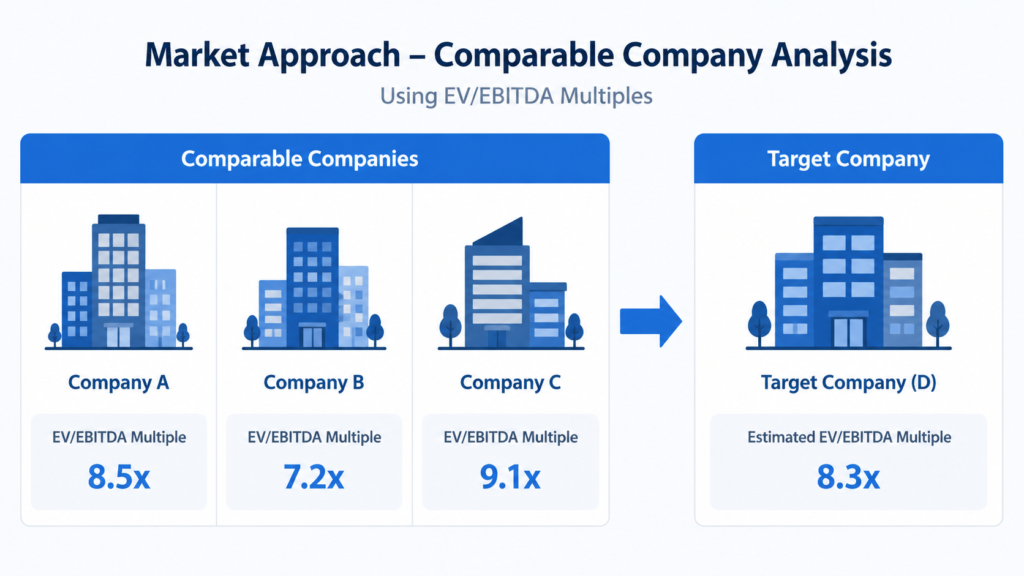
Comparable company analysis starts with careful, deliberate peer group selection among publicly traded businesses. Analysts identify companies operating in similar industries, at similar sizes, growth rates, and geographic markets relative to the target.
Once the comparable companies valuation peer group has been finalized, analysts gather relevant pricing multiples from public filings. Common choices include the P/E multiple, EV/EBITDA multiple, and revenue multiple, depending on data availability.
A practical comps example applies the median peer multiple directly to the target company’s own earnings or revenue figures. Comps limitations include imperfect peer matching and distortions caused by unusual, one-time market events affecting pricing.
Precedent Transaction Analysis
Precedent transaction analysis examines completed comparable transactions within the same or a closely related industry over time. Unlike trading comps, this method captures actual prices paid when one company acquired or merged with another.
M&A transaction multiples typically run noticeably higher than public trading multiples for comparable businesses. This gap reflects a genuine control premium, the extra amount buyers willingly pay for outright control rather than a minority ownership stake.
Sourcing reliable precedent transactions example data usually requires access to a specialized transaction database or subscription service. Precedent transaction limitations include limited deal availability, aging historical data, and confidential terms that never reach public record.
Market Capitalization Method
The market capitalization method applies only to publicly traded companies with actively traded shares on an exchange. It offers the most direct, real-time snapshot of what the broader market currently believes a company is worth.
The market cap formula itself is straightforward: current stock price valuation multiplied by total outstanding shares in circulation. This figure represents equity value specifically, not total enterprise value, so further adjustments are often still needed.
This market cap method works well for quick, everyday, day-to-day reference purposes across most public companies. Public company valuation teams still pair it with other methods, since share prices can swing sharply on sentiment rather than fundamentals.
Choosing the Right Valuation Multiple for Your Industry
Valuation multiples by industry vary considerably from sector to sector, since different industries reward different financial metrics. Capital-intensive industries often lean on EBITDA multiples, while software companies frequently emphasize revenue-based multiples instead of earnings.
EBITDA multiple selection suits companies carrying significant depreciation or debt-driven capital structures on their balance sheets. The revenue multiple vs earnings multiple decision often comes down to whether a company is currently profitable at all.
Industry-specific multiples exist largely because growth rates, profit margins, and risk levels differ so widely across sectors. Choosing a multiple correctly means matching sector valuation benchmarks to the company’s actual business model, stage, and profile.
Several appropriate multiple factors deserve careful attention beyond industry classification alone. Company size, growth trajectory, profitability, and geographic market all influence which specific multiple produces the most defensible, realistic valuation outcome for the business.
Asset-Based Approach Methods, Explained
Asset-based approach methods calculate value directly from the balance sheet rather than projected future earnings. These techniques suit companies where tangible holdings matter more than ongoing operating performance or long-term growth potential and momentum.
The primary techniques include the net asset value method, the adjusted net asset method, and the liquidation valuation method used in distress situations. Each treats tangible asset valuation and intangible asset valuation somewhat differently in practice.
A basic asset valuation formula starts with total assets, then subtracts total liabilities recorded on the balance sheet. The book value method below shows the simplest version of this calculation, using figures pulled straight from the ledger.
More refined techniques go further and adjust those raw balance sheet figures meaningfully. The adjusted net asset method restates assets and liabilities closer to current fair market value, rather than relying on historical accounting cost alone.
This broad asset approach example category matters most for holding companies, real estate portfolios, and businesses nearing closure or liquidation. Growth-oriented companies typically find little practical relevance in pure asset-based figures on their own.
Book Value Method
The book value method is the simplest asset-based technique available to any analyst working today. It uses figures already recorded directly on a company’s balance sheet, requiring no additional market research or forward-looking projections whatsoever.
The book value formula itself is direct: total assets minus liabilities, using standard historical accounting figures throughout. This balance sheet valuation produces shareholders’ equity, sometimes referred to as net worth or stockholders’ equity instead.
Book value limitations are significant, since historical cost rarely reflects current real-world market conditions accurately. A simple book value example shows why: land purchased decades ago may now be worth considerably more than its recorded value.
Adjusted Net Asset Method
The adjusted net asset method restates balance sheet figures to reflect genuine fair market value adjustment, rather than outdated historical accounting cost. This produces a noticeably more realistic picture of a company’s current true worth.
Analysts search carefully for hidden reserves, meaning assets carried below their true market value on the books. Real estate, equipment, and certain long-term investments frequently qualify for meaningful asset revaluation during this detailed review process.
The resulting adjusted NAV figure often differs meaningfully from a company’s simple book value calculation. This net asset value adjustment process requires more research effort but delivers a considerably more accurate and defensible valuation outcome overall.
Liquidation Value Method
Liquidation value estimates what a company’s assets would realistically fetch if sold quickly, often under significant time pressure. This resulting figure typically sits below both book value and any going-concern valuation estimate calculated separately.
The liquidation valuation formula subtracts estimated selling costs and outstanding liabilities from the forced sale value of the underlying assets. Distressed, compressed timelines usually mean assets sell for meaningfully less than fair market value.
When liquidation value applies matters greatly for correct interpretation of the resulting figure. This liquidation basis valuation fits closing businesses specifically; the liquidation vs going concern distinction should never be ignored during any thorough valuation review.
Specialized and Alternative Valuation Methods
Beyond the three core approaches, several specialized valuation methods address genuinely unique business situations effectively. These alternative valuation techniques handle companies where traditional income, market, or asset methods fall meaningfully short of expectations.
Startup valuation methods deserve particular attention, since early-stage companies often lack earnings, comparable peers, or substantial recorded assets. The venture capital method, Berkus method, and scorecard valuation method all help fill this practical gap.
Larger, more complex organizations sometimes need sum of the parts valuation, especially conglomerates operating across several unrelated business segments simultaneously. This technique values each segment separately before eventually combining them into one final combined total.
Private equity transactions frequently rely on leveraged buyout analysis, or LBO valuation, which models expected returns under significant acquisition debt. Real options valuation and the first chicago method address other distinct, less common valuation scenarios entirely.
These non-traditional valuation methods matter most for pre-revenue valuation and general early-stage company valuation work specifically. Choosing correctly among them depends heavily on the company’s stage, structure, and genuinely available supporting data throughout.
Startup and Early-Stage Valuation Methods
Startup valuation methods exist because traditional techniques struggle badly with companies lacking revenue, earnings, or long operating histories to reference. Investors needed practical alternatives suited specifically to genuine early-stage uncertainty and limited financial data.
The venture capital method works backward from an expected future exit value, discounting it back to present terms. The Berkus method instead assigns specific dollar values to qualitative risk-reduction milestones the company has already achieved.
The scorecard method and risk factor summation approach compare a startup against typical funded companies, adjusting a baseline valuation figure up or down. Both approaches ultimately produce a pre-money valuation figure before any new investment.
Adding new investment capital on top produces the resulting post-money valuation figure for the company. Early-stage valuation challenges include unpredictable growth, minimal data, and heavy reliance on founder and market assumptions rather than hard historical numbers.
A simplified startup valuation example might combine several of these methods and average the resulting figures together. This blended approach helps offset the inherent weaknesses of any single pre-revenue company valuation technique when used entirely alone.
Sum-of-the-Parts (SOTP) Valuation
Sum of the parts valuation, or the SOTP method, values a multi-division company by assessing each individual business segment valuation separately, then adding everything together into one combined total figure overall.
This technique suits conglomerate valuation work especially well, since different divisions often operate in entirely different industries with different economics. Applying one blended multiple to the whole company would seriously misrepresent its true underlying value.
A divisional valuation approach might apply an income approach to one specific segment and a market approach to another entirely. This SOTP example reflects how differently each individual business unit actually operates day to day.
Leveraged Buyout (LBO) Analysis
Leveraged buyout analysis models how a company might realistically perform under a debt-heavy acquisition structure over time. Private equity valuation teams use this method to test whether a proposed deal can generate targeted investor returns.
LBO valuation relies heavily on projecting cash flows toward scheduled debt repayment over a defined holding period, typically several years. The LBO method then calculates the return an investor would ultimately realize at the eventual exit.
Understanding LBO model basics helps explain the maximum affordable purchase price for a given deal. This debt-financed acquisition valuation approach differs fundamentally from other methods, since it centers on financing structure rather than pure intrinsic worth.
How to Choose the Right Valuation Method for Your Situation
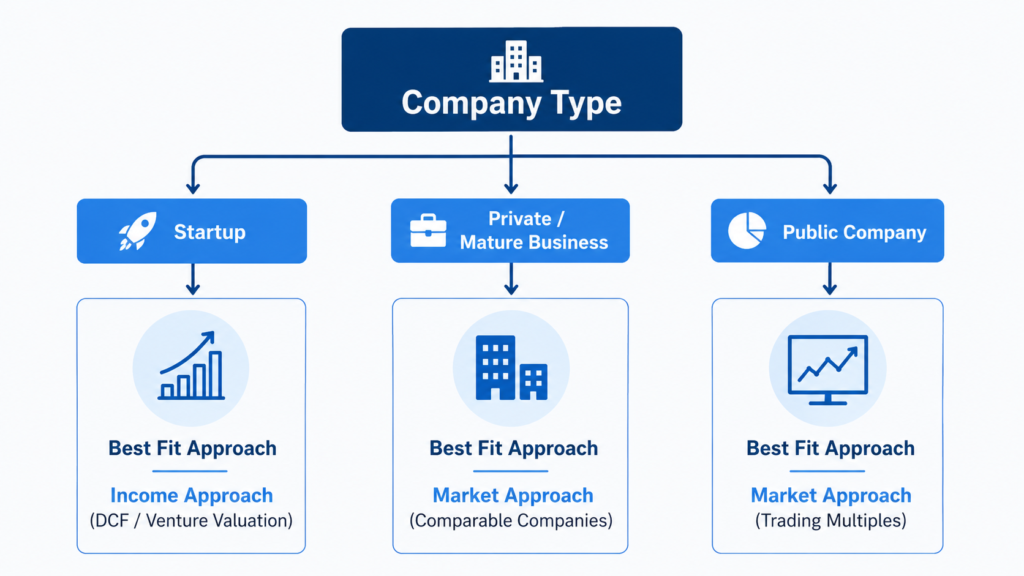
How to choose a valuation method depends heavily on company stage, industry, and the specific reason behind the valuation exercise itself. No single technique works correctly for every possible business situation encountered in practice.
The best valuation method for startups usually differs sharply from the best valuation method for private companies or the best valuation method for public companies already trading actively on an exchange somewhere.
Valuation method selection criteria include data availability, company maturity, and prevailing industry norms across the sector. Valuation by company stage matters enormously, since early-stage companies and mature firms face completely different analytical challenges throughout the process.
Valuation by industry type also shapes the final decision quite meaningfully in most cases. Choosing between DCF and comps often comes down to whether reliable projections or strong peer data are more readily and reliably available.
This overall valuation decision framework ultimately centers on matching method to purpose carefully and consistently. Understanding valuation method suitability for each specific situation prevents wasted analytical effort and produces far more defensible, credible final results overall.
Valuing a Startup or Early-Stage Company
A sound startup valuation approach typically blends multiple specialized techniques together rather than relying on just one single method. This early-stage company valuation method choice directly reflects the inherent uncertainty surrounding young, unproven companies generally.
Pre-revenue valuation choice often favors the venture capital method or Berkus method over more traditional income approaches entirely. These specific techniques accommodate missing financial history far better than a standard discounted cash flow calculation would.
For growth-stage valuation situations involving some early revenue, venture-backed valuation work sometimes blends early-stage techniques with simplified market comparisons together. This startup method selection process naturally evolves further as the company continues maturing over time.
Valuing a Private, Mature Business
Private company valuation for established, profitable businesses often centers on capitalization of earnings or discounted cash flow analysis, supported by whatever comparable private transaction data happens to exist for reference purposes.
Mature business valuation benefits considerably from stable historical financials, which makes income-based methods far more reliable overall. Small business valuation method choices frequently favor simpler earnings multiples over complex, multi-year cash flow projections requiring extensive assumptions.
This private business method choice should still be cross-checked carefully against asset-based valuation, particularly for genuinely asset-heavy operations. Established company valuation work generally benefits significantly from applying more than one technique together for confirmation.
Valuing a Publicly Traded Company
Public company valuation naturally leans heavily on market approach techniques, since abundant trading data and peer comparisons already exist readily. Listed company valuation method choices frequently start directly with existing market capitalization figures already available.
Market-based public valuation work often incorporates comparable company analysis using other actively exchange-listed peer companies for reference. This public company method choice benefits from transparent, frequently updated financial disclosures required consistently by securities regulators everywhere.
A thorough stock valuation approach still typically layers in discounted cash flow analysis for meaningfully deeper insight beyond surface pricing. Publicly traded business valuation rarely relies on just one single method for a truly complete final picture.
Step-by-Step: How to Actually Run a Company Valuation
Learning how to value a company step by step turns abstract theoretical methods into a genuinely repeatable valuation process anyone can follow. This practical valuation workflow applies regardless of which specific method ultimately gets used.
The general valuation methodology process follows a fairly consistent sequence across most situations and industries. Gathering financial data for valuation comes first, followed by careful preparation before any formula or calculation gets meaningfully applied to the underlying numbers.
Normalizing financial statements removes distortions that would otherwise seriously skew the final results downstream. This financial statement preparation for valuation step matters regardless of whether the final chosen method is income, market, or asset-based entirely.
Running a valuation typically means applying multiple methods together rather than relying on just one. Cross-checking results against each other builds genuine confidence and highlights any assumptions that might still need further careful review beforehand.
This practical valuation checklist approach keeps the entire process organized, consistent, and fully defensible throughout. The four steps outlined below form a complete, practical valuation guide that applies broadly across most common valuation situations encountered.
Step 1: Gather and Normalize Financial Statements
The first step involves carefully normalizing financial statements to reflect true, ongoing operating performance accurately. Analysts remove non-recurring expenses, one-time gains, and owner-specific costs that would otherwise distort the underlying operating picture significantly.
This detailed financial statement cleanup process produces adjusted earnings, a considerably more reliable foundation for any subsequent calculation. Without these careful normalization adjustments, later valuation steps risk building on flawed, incomplete, or genuinely misleading underlying data.
Step 2: Select the Appropriate Method(s)
Selecting valuation method choices depends heavily on the company’s stage, industry, and overall available data quality. This method selection process should reference the decision framework covered earlier throughout this guide for consistency and reliability.
Matching method to company characteristics improves overall reliability quite significantly across most valuation scenarios encountered. Many experienced analysts favor a multiple methods approach, since combining techniques helps confirm method appropriateness and reduces reliance on any single formula.
Step 3: Apply the Method and Calculate
Applying valuation formula steps requires careful, sustained attention to every single input used throughout. Running the calculation accurately depends heavily on double-checking each individual figure before it feeds into the broader overall valuation model.
Every method needs specific valuation inputs, whether projected cash flows, comparable multiples, or existing balance sheet figures. This documented calculation process should be recorded clearly to support later review, cross-checking, and eventual defense of results.
Careful method application avoids simple arithmetic errors that could otherwise meaningfully distort the final overall valuation figure. Reviewing each calculated output against reasonable expectations catches most mistakes early, well before they compound further downstream.
Step 4: Reconcile Multiple Methods Into One Value
Reconciling valuation methods means carefully comparing results produced by genuinely different techniques applied to one target. Weighting valuation results allows analysts to emphasize the most reliable method given the company’s specific circumstances and available data quality.
Triangulating valuation outputs often produces a defensible valuation range rather than one single precise number outright. This range communicates appropriate uncertainty honestly, especially where underlying assumptions carry meaningful risk of ultimately proving wrong.
Combining these weighted results produces a blended valuation, sometimes simply called the final valuation number overall. This resulting figure should always be presented alongside the key assumptions and methods that shaped its original calculation.
Common Mistakes That Distort a Company Valuation
Valuation mistakes happen even to genuinely experienced analysts, often through small errors that compound significantly over time. Recognizing these common valuation errors early helps protect the overall credibility of any final valuation figure produced.
A wrong discount rate ranks among the most damaging possible mistakes an analyst can make. Since discounting compounds meaningfully over many years, even small rate errors can meaningfully shift the resulting present value calculation substantially over time.
Bad comparable selection distorts market-based methods just as severely as any other error. Choosing peers that differ meaningfully in size, growth rate, or geography produces multiples that simply do not fit the target company well.
Overly optimistic projections inflate income-based valuations quite unrealistically in many cases observed regularly. Analysts should stress-test their assumptions against historical performance and industry norms, rather than simply assuming best-case growth will continue indefinitely into the future.
Ignoring control premium figures, along with other common valuation pitfalls, rounds out this broader list of inaccurate valuation causes overall. Watching consistently for these valuation red flags supports genuinely avoiding valuation errors across every stage of the process.
Frequently Asked Questions
What is the most accurate method to value a company?
There is no single most accurate valuation method that works correctly for every possible situation encountered. The best valuation method depends heavily on company stage, data quality, and purpose, making valuation method reliability highly context-dependent overall.
DCF accuracy tends to be genuinely strong for predictable, mature businesses but noticeably weaker for volatile ones. Combining several techniques together generally produces a more accurate company value than relying on just one method alone.
Which valuation method is best for a startup with no revenue?
Startup valuation on revenue situations typically call for the venture capital method or Berkus method instead, since traditional income approaches require earnings data that pre-revenue companies simply do not yet have.
The pre-revenue method choice depends heavily on how much traction the company has already demonstrated so far. Many investors treat the best startup valuation method as a blended estimate combining several different approaches together for reliability.
What’s the difference between valuation approach and valuation method?
The approach vs method distinction is genuinely foundational valuation terminology worth understanding clearly. An approach is a broad category, like the income market asset approaches, while a method is the specific formula applied within it.
This valuation classification matters greatly for clear communication among practicing analysts and clients. Every specific technique, from DCF to comps, represents one method under approach, nested beneath one of the three core categories described earlier.
How many valuation methods should I use?
Using multiple valuation methods together is generally considered strong best practice, rather than relying on just one calculation alone. The question of how many methods to use depends heavily on available time, data, and overall purpose.
Cross-checking valuation results across two or three techniques supports genuinely meaningful valuation triangulation throughout the process. This method combination approach helps identify outliers early and strengthens overall confidence in the final reconciled value produced.
What discount rate should I use in a DCF valuation?
Discount rate selection typically starts with a careful WACC calculation, reflecting the company’s blended cost of debt and equity financing combined. This resulting figure should closely match the risk profile of the projected cash flows.
The appropriate discount rate varies considerably by industry, company size, and existing capital structure overall. This general DCF discount rate guidance should be adapted carefully to each company’s specific financing arrangement and underlying risk situation.
Can I value my company myself, or do I need a professional appraiser?
DIY company valuation is genuinely possible for informal, internal purposes using publicly available methods and data sources. More formal situations typically call for a professional business appraiser with recognized credentials and demonstrated experience instead.
A certified valuation analyst brings specialized training and defensible methodology to genuinely complex situations requiring precision. Knowing when to hire an appraiser matters most where legal, tax, or transaction stakes are meaningfully high overall.
Self valuation limitations include potential personal bias and limited access to comparable transaction data generally. Professional appraisers typically carry access to private databases entirely unavailable to individual business owners performing valuations independently on their own.
What’s the difference between valuing a private company and a public company?
The private vs public valuation distinction centers mainly on data availability and overall transparency levels between the two. Public companies offer transparent, regularly updated financials, while private companies often require more assumptions and normalization adjustments throughout.
Comparing market cap vs comps approaches highlights this underlying gap quite clearly across most situations. A private company discount sometimes applies, reflecting reduced liquidity, compared to the public company transparency built into listed company valuation.
This listed company valuation difference ultimately affects which methods work best for each. Private valuations often lean more heavily on income and asset approaches, while public valuations lean more toward market-based comparison techniques instead.
Why do different valuation methods give different results for the same company?
Valuation method discrepancy is entirely normal and expected, not necessarily a sign of error somewhere. Each technique relies on different assumptions, data sources, and time horizons, naturally producing a reasonable and defensible valuation range explanation overall.
These differing valuation outcomes stem mainly from underlying method assumption differences, such as growth rates, discount rates, or peer group selection choices. Understanding these valuation variance causes helps interpret conflicting results with appropriate context and reasonable confidence.