
What Is Equity Research? (Definition and Core Purpose)
Equity research is the professional practice of analyzing publicly traded companies to help investors make informed decisions. Analysts study a company’s business model, financial health, and growth prospects, then share findings through a written report.
The equity research definition goes beyond simple number-crunching. It blends financial analysis and recommendations with judgment about industry trends, competitive positioning, and management quality. A skilled research analyst connects raw data to a coherent outlook.
At its core, equity research answers one question: is this stock worth owning? Analysts translate that question into an investment thesis, supported by financial models, forecasts, and comparisons. This thesis anchors every published research report.
Most equity research comes from an investment bank division dedicated to covering specific sectors. These divisions employ teams who specialize in stock coverage across dozens of companies. Their work shapes how institutional investors allocate capital.
The final product typically includes a buy hold sell rating, a price target, and supporting analysis. These stock analysis reports give investors a structured way to compare opportunities and understand what equity research means.
Who Produces Equity Research and Who Uses It
Equity research is produced by several types of organizations, each serving different audiences. Investment banks run large research divisions covering hundreds of companies. Independent firms and brokerages also publish research, though incentives and independence differ.
An equity research analyst typically leads coverage of a specific sector, supported by an equity research associate who handles modeling and data work. Together, they maintain sector coverage, tracking earnings, competitive shifts, and macro trends.
On the consumer side, institutional investors such as hedge funds and mutual funds rely heavily on this research to inform trading decisions. These financial institutions often pay for premium access, since timely insight affects performance.
Retail investors represent a smaller but growing group of research consumers. They typically access simplified versions of research through brokerage platforms, without the depth available to institutional clients. This gap shapes how individuals use research.
Wall Street analysts work within a broader research division structure, often organized by industry. Whether at asset management companies, brokerage firms, or independent houses, their goal stays similar: turning data into actionable, well-supported investment insight.
Sell-Side Equity Research
Sell-side research originates from an investment bank research division or brokerage firm. This client-facing research reaches the firm’s clients, typically institutional investors, as part of a broader relationship that may include trading and banking services.
Sell-side analysts maintain a stock coverage universe, publishing updates on assigned companies. Historically, research commissions funded work through trading fees. Regulatory changes like MiFID II reshaped this paid research model, separating research and trading costs.
The sell-side analyst role involves constant communication with company management, investors, and internal trading desks. Analysts must balance objectivity with commercial pressures, since their firm may seek investment banking relationships with the companies they cover.
Buy-Side Equity Research
Buy-side research is conducted internally by firms that manage money directly, rather than distributing research externally. A hedge fund analyst or mutual fund analyst produces this internal investment research to support the firm’s trading decisions.
Unlike sell-side output, this proprietary research stays private within the firm. It directly shapes investment decision-making for portfolio managers, who rely on in-depth analysis tailored to the fund’s specific strategy, risk tolerance, and time horizon.
The buy-side analyst role differs from its sell-side counterpart in accountability. Buy-side analysts answer to portfolio managers, not external clients, giving them freedom to express contrarian views without worrying about client relationships or banking conflicts.
Independent and Retail-Accessible Research
Independent research providers operate without investment banking ties, aiming to offer unbiased equity research. These firms earn revenue through subscriptions rather than banking fees, which can reduce certain conflicts that affect traditional sell-side research models.
Retail investor access to quality research has expanded through brokerage research access programs and subscription research services. Many brokerages now bundle basic research with trading accounts, narrowing the historical gap between institutional and everyday investors.
Research aggregators and individual investor tools compile research from multiple sources into one platform. Some offer free equity research summaries, while premium tiers provide full reports. This layered model reflects growing demand among self-directed investors.
How Equity Research Analysts Do Their Work
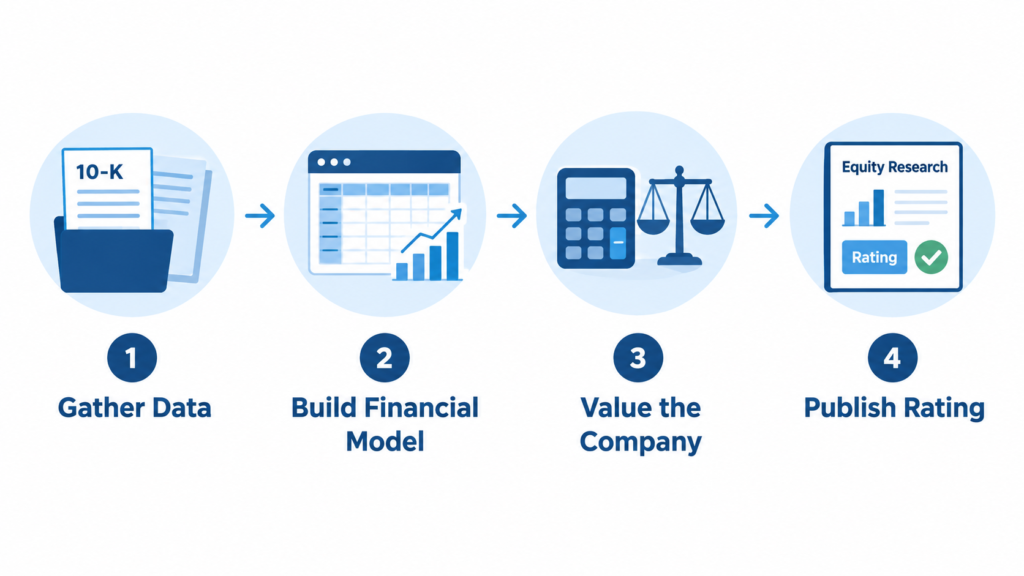
The research process begins with company filings analysis, starting with 10-K analysis and quarterly reports. Analysts extract revenue trends, margin patterns, and balance sheet details. This groundwork forms the essential factual foundation for every conclusion.
Beyond filings, analysts study earnings call transcripts closely, listening for management tone and forward guidance. Direct management interviews and site visits often add context numbers alone cannot always capture, revealing strategic priorities and operational challenges.
Industry research and competitive analysis place the company within its broader market. Analysts compare growth rates, market share, and pricing power against rivals. This primary research separates company-specific performance from broader industry or economic trends.
Financial modeling turns this information into structured financial forecasting. Analysts build valuation models, often including a DCF model and comparable company analysis, to estimate fair value. These models need constant updates as new data arrives.
When a firm begins initiating coverage, analysts produce a comprehensive first report. After that, quarterly earnings updates keep coverage current. Throughout, research report writing demands clarity, since complex analysis must reach busy, time-constrained readers quickly.
What’s Inside an Equity Research Report
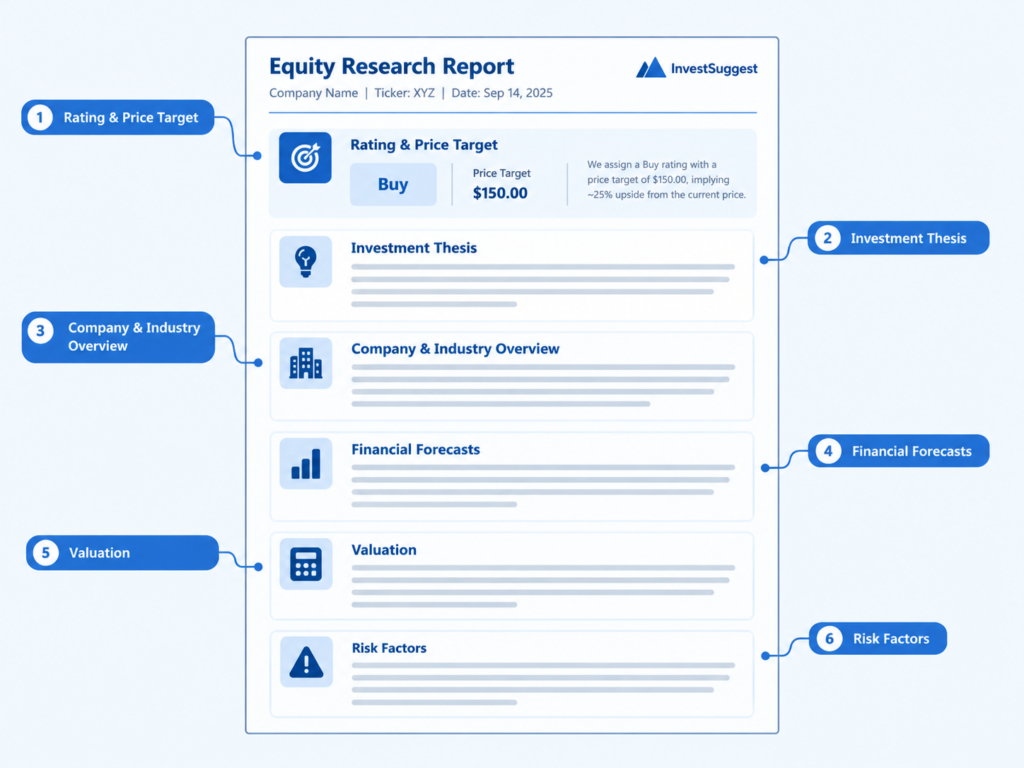
Every equity research report follows a broadly similar equity research report structure, designed for quick scanning. Most reports open with a buy hold sell recommendation and a target price, stating the headline conclusion before detail.
The company overview section introduces the business, its segments, and revenue drivers. This section orients readers unfamiliar with the company, setting context for the more technical financial analysis that follows in the report’s later sections.
Industry analysis situates the company within its competitive landscape, covering market size, growth trends, and key competitors. This section connects company-specific performance to broader forces shaping the sector’s trajectory over the coming quarters and years.
The financial forecasts section presents projected revenue, earnings, and cash flow. Analysts typically include EPS estimates alongside historical figures, allowing readers to compare projected growth against past performance and relevant industry benchmarks side by side.
The valuation section explains how the target price was calculated, often referencing price to earnings ratio and EV/EBITDA multiples. A risk factors section closes most reports, outlining what could challenge the underlying investment thesis directly.
Types of Equity Research Reports
An initiation report, marking the start of coverage initiation, offers the deepest analysis a firm will publish on a company. It includes full financial models, detailed industry analysis, and an extensive explanation of the reasoning.
An update report follows regular events like earnings releases, providing a shorter, more focused earnings update report. A flash report responds to breaking news, while an earnings preview report sets expectations before results are announced.
Longer sector reports and industry note publications step back from individual companies, examining broader themes. These differ from a comprehensive research report on one stock, and a short research note on a truly minor development.
How to Read and Interpret a Rating and Price Target
A buy rating typically signals an analyst expects the stock to outperform. A hold rating meaning suggests roughly market-level performance, while a sell rating meaning signals expected underperformance relative to peers or a benchmark.
Some firms use an overweight underweight rating system instead, comparing a stock’s expected performance to its sector or index weighting. This differs from simple buy or sell language, reflecting relative rather than absolute return expectations.
The price target definition refers to a projected share price, often set as a 12-month price target. Readers should study the target price assumptions behind it, since how reliable are price targets varies by analyst.
Equity Research vs. Other Types of Financial Analysis
Comparing equity research vs technical analysis highlights a key distinction. Equity research relies on company fundamentals, filings, and forecasts. Technical analysis instead studies price charts and trading patterns, largely ignoring the underlying business quality entirely.
The relationship between equity research vs fundamental analysis is closer, since equity research applies fundamental principles within a formal report structure. Fundamental analysis is the broader method; equity research applies that method for investment purposes.
Looking at equity research vs financial statement analysis shows another layer of distinction. Financial statement analysis focuses narrowly on the numbers. Equity research incorporates those numbers alongside industry context, management assessment, and forward-looking valuation work.
The difference between equity research vs company valuation matters too. Valuation is one component within a research report, not the entire discipline. Equity research combines valuation with narrative, forecasting, and ongoing company monitoring over time.
Understanding equity research vs investment analysis requires recognizing overlap. Investment analysis is a qualitative vs quantitative blend applied broadly, sometimes using top-down vs bottom-up analysis. Equity research is one structured form of that broader tradition.
Conflicts of Interest and Limitations of Equity Research
Analyst conflicts of interest represent a well-documented limitation of sell-side research. Firms with investment banking relationships to a covered company may face pressure to publish favorable coverage, since banking revenue often exceeds direct research revenue.
To manage this, firms maintain a Chinese wall separating research teams from banking divisions. Research analyst regulations require disclosure of banking relationships within reports, giving readers a way to judge bias before relying on conclusions.
MiFID II unbundling rules, introduced in Europe, forced firms to price research separately from trading services. This shift aimed to improve research independence by removing financial incentives tied to trading volume rather than research quality.
Data on buy rating bias shows sell-side ratings skew more positive than negative historically. This pattern reflects both genuine optimism about markets and structural incentives favoring positive coverage, since negative ratings can strain client relationships.
How to evaluate research credibility starts with reading disclosures carefully. Readers should note any investment banking relationships, check the analyst’s track record, and treat every rating simply as only one input, not a final answer.
How Individual Investors Can Access and Use Equity Research
Learning how to get equity research reports starts with checking your brokerage account. Most major brokerages now offer some free equity research access as part of standard account features, particularly for actively traded, well-covered companies.
Brokerage research reports vary in depth depending on the provider. Some offer full sell-side reports from partner banks. Others provide summarized versions or proprietary in-house analysis, designed and built specifically for retail investor research tools.
Using equity research for stock picking works best as one part of a broader process. Reports provide structured analysis, but combining research with your own analysis helps investors form independent, well-reasoned conclusions, not blind trust.
This reflects a core principle: treat research as one input not a decision. No single report accounts for personal risk tolerance, time horizon, or portfolio context, all of which matter as much as analysis itself.
Evaluating analyst track record and watching for research report red flags, like vague reasoning or unclear assumptions, helps investors judge quality. Some also explore independent research subscriptions for perspectives less tied to traditional banking relationships.
Careers in Equity Research
An equity research analyst career typically begins with an equity research associate role, supporting senior analysts with modeling and data gathering. This apprenticeship period builds the technical foundation needed to eventually manage independent company coverage.
Learning how to become an equity research analyst usually involves strong financial modeling skills, attention to detail, and clear writing ability. Many professionals pursue the CFA charter to demonstrate technical credibility and further deepen expertise.
The equity research skills required extend beyond spreadsheets. Analysts need strong communication skills, since reports must translate complex analysis into clear conclusions. Sector knowledge, developed over years of coverage, becomes an increasingly valuable long-term asset.
Comparing equity research vs investment banking career paths shows different daily rhythms. Investment banking centers on deal execution and client pitches, while equity research emphasizes continuous, deep analysis of a group of companies over time.
Exit opportunities from equity research often lead toward buy-side research, portfolio management, or corporate strategy roles. Career progression typically moves from associate to analyst, then toward senior or director-level sector leadership positions within larger organizations.
Frequently Asked Questions
Is equity research the same as investment advice?
No. Equity research provides analysis and a buy hold sell rating, but this differs from personalized investment advice. A financial advisor considers your specific goals and risk tolerance, while research reports remain general and impersonal, meant only as research as one input.
How accurate are equity research price targets?
Price target accuracy varies significantly across analysts, sectors, and market conditions. Studies on analyst forecast reliability show meaningful forecast error, particularly over longer horizons. Reviewing an analyst’s analyst track record and understanding target price assumptions helps readers judge how much weight to give any single projection.
Can individual investors trust sell-side equity research given bank conflicts of interest?
Sell-side research carries structural analyst bias risk, given investment banking pressure within many firms. Regulations like the Chinese wall and MiFID II aim to protect research independence, but readers should still check disclosures and consider research as one input rather than an unquestioned source of truth.
What’s the difference between an equity research analyst and a financial analyst?
The equity research analyst vs financial analyst distinction comes down to scope. Equity research analysts focus specifically on publicly traded stocks and sector specialization, producing external reports. A corporate finance analyst, by contrast, typically works inside a company, supporting internal budgeting, forecasting, and strategic decisions rather than public stock coverage.
How do I access equity research reports for free?
Free research access is often available through your brokerage account research section, which may include partner reports from major banks. Some research aggregators and public equity research platforms also publish summaries at no cost, making them useful retail research tools for investors without premium subscriptions.
What qualifications do you need to become an equity research analyst?
Most analysts hold a finance-related finance degree, supplemented by strong financial modeling skills and analytical ability. Many pursue the CFA charter to build credibility and technical depth. Entry-level roles, such as an equity research associate, often serve as the standard starting point before advancing toward full analyst responsibilities.
What’s the difference between an “Overweight” rating and a “Buy” rating?
These terms often overlap, but reflect different rating terminology differences. Overweight vs buy distinctions matter because overweight is a relative, benchmark-relative rating, comparing a stock to its sector or index. A buy rating within an analyst rating scale is typically an absolute call on expected performance, independent of benchmark weighting, though usage varies by firm-specific ratings conventions.